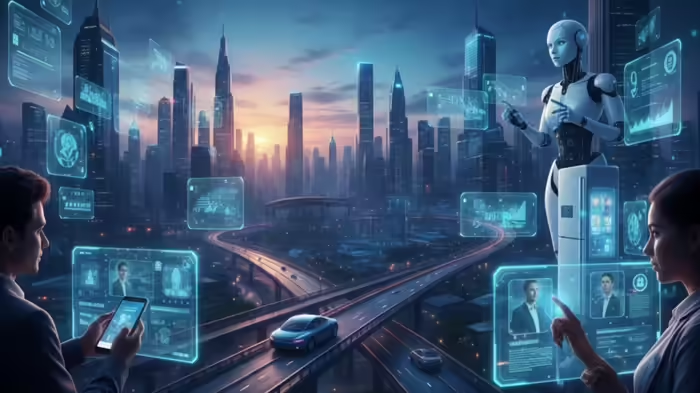
The pace at which artificial intelligence evolved in 2025 made one thing clear: the future is not just about advanced technology, but about the re-design of human life itself. From agentic AI and multimodal systems to medical breakthroughs and smarter AI chips, the foundations have already been laid.
Now, 2026 is expected to be the year when AI truly becomes personal—acting as an assistant, doctor, tutor, manager, and even a decision-maker. The coming year may not merely showcase the future, but mark the beginning of living with AI.
Here are 10 major AI-driven transformations expected in 2026:
1. On-Device AI Becomes the Norm
Smartphones are rapidly turning into AI-first devices. Already, over 30% of flagship phones support on-device AI models that function without sending data to cloud servers.
By 2026, phones will proactively manage tasks such as bill reminders, recharge alerts, meeting preparation, and daily scheduling—without internet dependency. These capabilities are expected to reach even mid-range smartphones.
2. AI Transforms Healthcare
Healthcare may see one of the biggest disruptions. Smartwatches and wearables will evolve into AI-powered health monitors, capable of predicting flu, viral infections, or fatigue within 24 hours by analyzing sweat, blood pressure, and heart-rate patterns.
Early detection of diseases like cancer and heart attacks is expected to become more affordable and accessible, with tech giants like Google and Apple offering AI-driven health coaching based on user data.
3. Chatbots Turn into Autonomous AI Agents
The biggest leap in 2026 will be the rise of agentic AI. Instead of just answering questions, AI agents will perform tasks independently—booking flights, reserving hotels, scheduling cabs, drafting emails, and managing calendars.
Experts from OpenAI and Microsoft predict that by 2026, most individuals will have a personal AI agent capable of operating apps like Uber, Swiggy, and MakeMyTrip autonomously.
4. Personalized AI Tutors for Every Student
AI tutors will become cheaper, smarter, and widely available. These tutors will adapt to each student’s learning speed, strengths, and weaknesses.
Children will study at home using AI teachers that speak their native languages, ask questions interactively, and explain mistakes instantly. Language barriers may disappear, enabling students from rural India to learn complex subjects in their local dialects.
5. Smart Homes and Household Robots
While humanoid robots like Elon Musk’s Optimus may initially enter affluent households, AI-powered smart homes will become common.
Refrigerators will automatically reorder groceries, kitchen appliances will prevent overcooking, gas leaks will trigger alerts, and child safety modes will activate automatically—all powered by edge AI and the Matter protocol.
6. The Changing Job Landscape
According to Stanford University reports, generative AI will place increased pressure on roles such as customer support, content writing, data entry, basic coding, and routine office work.
However, jobs involving creativity, strategic planning, fieldwork, and human interaction are expected to remain relatively secure. At the same time, entirely new AI-related roles will emerge, reshaping the workforce.
7. Entertainment Enters the Age of Generative Media
Choosing what to watch may become effortless. By 2026, users could simply ask for a movie featuring a 1990s-style Shah Rukh Khan, a Harry Potter-like storyline, and Jaipur as the setting—and AI would generate it within minutes.
Tools like Sora and Runway are expected to mature to a point where individuals can create Hollywood-level visual content from home.
8. AI in Public Transport and Mobility
Fully driverless cars may not dominate Indian roads by 2026, but AI co-pilots will become standard. Vehicles will track driver alertness, slow down during fatigue, and communicate with nearby cars to prevent accidents.
AI-controlled traffic signals could reduce travel time by 20–30%, while buses and metro systems will offer highly accurate real-time tracking.
9. Security, Deepfakes, and Digital Law
As AI becomes more powerful, risks will increase. Deepfake scams using cloned voices and videos are expected to rise, prompting stricter regulations on data protection and accountability.
Banks and social media platforms will deploy AI security guards to verify identities using facial recognition, voice patterns, and behavioral data—potentially making traditional passwords obsolete.
10. Massive Investment in AI Infrastructure
2026 will see heavy global investment in AI infrastructure, including cloud-edge integration, advanced chips, and energy-efficient data centers.
Demand for GPUs, TPUs, and AI-specific hardware will surge, while green data centers and AI-driven energy management systems will become top priorities worldwide.
The Bigger Picture
AI in 2026 will no longer be a futuristic concept—it will be an everyday companion shaping how people work, learn, travel, and stay healthy. The real question will not be whether AI transforms life, but how responsibly humanity chooses to use it.
Discover more from SD NEWS agency
Subscribe to get the latest posts sent to your email.