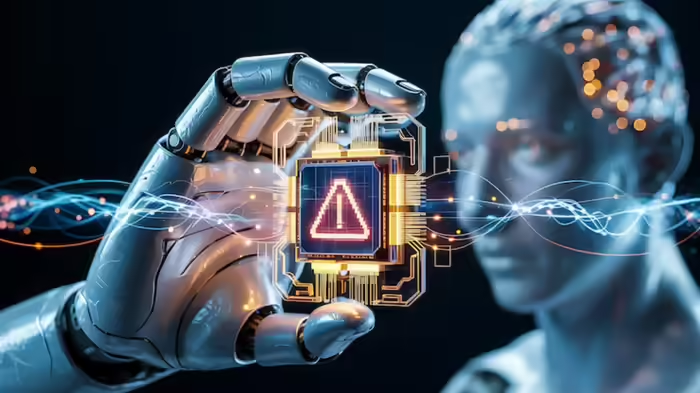
Artificial Intelligence (AI) is advancing at an unprecedented pace, and 2026 promises even faster development. However, a recent report highlights six potentially alarming predictions for AI, raising concerns about privacy, employment, and international stability.
1. AI Development May Slow Down
Global protests against the construction of new data centers are increasing, particularly in the U.S., where social media campaigns are gaining momentum. Countries like China and Russia could exploit this by spreading disinformation, slowing AI development in the West. This could lead to international tensions as misinformation fuels public unrest, hindering AI progress.
2. Bringing Robots into Homes Remains a Challenge
AI-powered robots will dominate tech conferences in 2026. Companies like Google are teaching robots household tasks such as folding clothes or sorting waste. Demonstrations may include tasks like placing pizza in ovens or retrieving drinks from the fridge. However, widespread home use will still require rigorous testing to prevent accidental damage.
3. AI Investment Bubble May Burst
Massive investments have flowed into AI companies, but a slowdown is possible in 2026. Some firms may reduce workforce to focus resources efficiently, similar to measures taken by Google three years ago. Market corrections could affect stock valuations and lead to reduced spending on AI initiatives.
4. Employee Monitoring to Train AI
Companies increasingly use monitoring software to track employee activities. In 2026, this data could be leveraged to train AI systems for complex tasks. While this may improve efficiency, it raises concerns about job security, employee privacy, and potential leaks of sensitive information.
5. AI Threatens Personal Privacy
AI tools that record meetings and generate notes, like Granola, have gained popularity. However, unauthorized or unnoticed AI monitoring could lead to significant privacy violations and legal challenges in 2026. Experts warn that companies must exercise caution to avoid ethical and legal complications.
6. Risk of Accidents May Increase
Robot taxi services in the U.S. are expected to expand rapidly, providing over a million rides per week across 25 cities. While data indicates robot taxis are generally safer than human-driven vehicles, experts caution that AI malfunctions could lead to accidents, sparking public concern.
As AI continues to shape our lives, society faces both tremendous opportunities and significant risks. Stakeholders must remain vigilant to harness AI’s potential while addressing ethical, safety, and privacy concerns.
Discover more from SD NEWS agency
Subscribe to get the latest posts sent to your email.