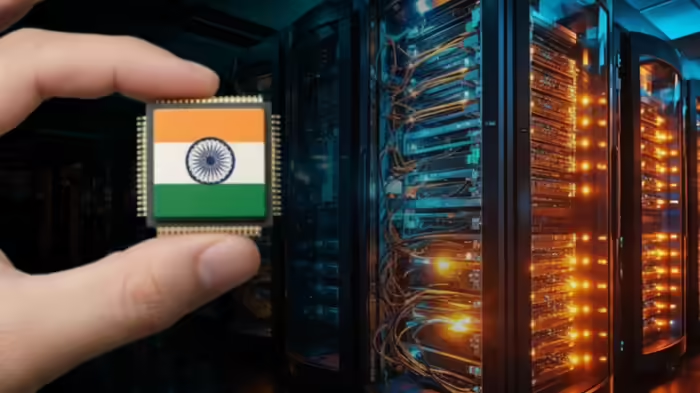
New Delhi: India is preparing to take a major leap toward technological self-reliance. According to Amitesh Kumar Sinha, head of the India Semiconductor Mission (ISM), the country will develop its first fully indigenous supercomputer by 2030, marking a historic milestone. The system is expected to enter the commercial market by 2032, making high-end computing accessible to industry, research institutions, and even the general public.
Sinha shared these details at the Supercomputing India 2025 Conference, emphasizing that India now aims to move beyond assembling mobile phones and televisions to manufacturing some of the world’s most powerful computing machines.
Over 50% Components Already Made in India
As reported by The Economic Times, more than 50% of the components used in India’s existing supercomputers are already manufactured domestically. This figure is projected to rise above 70% by the end of the decade.
To support this transition, the government has launched an ambitious program to boost production of electronic components. ISM has approved 10 major semiconductor projects focused on chip fabrication, packaging, and large-scale manufacturing.
Sinha noted that creating a fully homegrown supercomputer requires excellence in every layer of the technology stack—from chips to software—and India is now rapidly building that capacity.
How India Will Benefit
A domestically built supercomputer ecosystem is expected to deliver wide-ranging benefits:
- More accurate weather forecasting, helping reduce disaster-related losses
- Faster development of medicines and vaccines
- Boost to defence capabilities, including advanced missile systems and aircraft
- High-tech job creation for lakhs of young professionals
- Better planning of power, water, traffic and urban systems
- Improved advisory systems for farmers, based on climate and soil analytics
- Above all, a major stride toward technological self-reliance
NSM 2.0: India to Build Its Own CPU, GPU and AI Accelerators
In the second phase of the National Supercomputing Mission (NSM 2.0), India will design and build its own CPUs, GPUs and AI accelerators.
The roadmap is ready, and more than 38,000 GPUs have already been distributed to researchers, universities, and startups. Indian companies like MosChip are also developing chips for AI and supercomputing applications.
Electronics Manufacturing Grows Sixfold
India’s electronics sector has seen remarkable progress in the last decade:
- Electronics manufacturing has grown six times
- Exports have increased eightfold
- The mobile manufacturing sector has expanded 28 times, with exports up by 127 times
Sinha highlighted that India has moved from simple assembly to manufacturing core components, advancing deeper into the global value chain.
India Open to Global Collaboration
He added that India is eager to collaborate with the global community in semiconductors, quantum technologies and artificial intelligence—provided the technology serves the greater good of humanity.
Delegates from 20 countries are participating in the ongoing conference, signalling broad international interest.
India is no longer content being just a manufacturing hub for consumer electronics. It is now aiming to build some of the world’s most powerful computers, and if current progress continues, the country is on track to achieve this goal by 2030.
Discover more from SD NEWS agency
Subscribe to get the latest posts sent to your email.