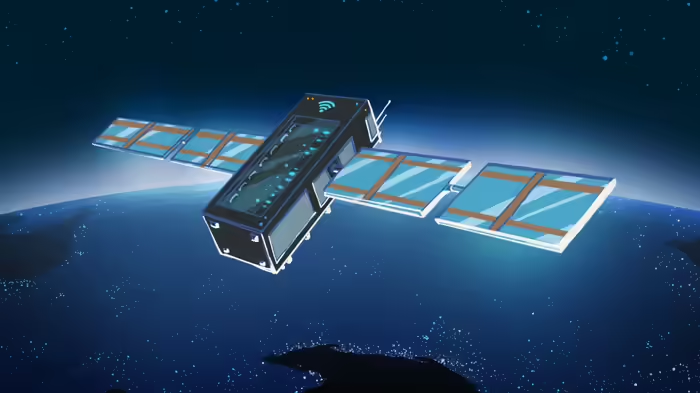
As the global battle for dominance in artificial intelligence intensifies, the United States is preparing to take a bold step that could push China far behind. A breakthrough project—something no country has attempted at scale—may soon reshape the future of AI computing: building data centers in space.
‘Galactic Brain’: The Plan to Take AI Computing Beyond Earth
Generative AI is booming worldwide, but scientists warn that the massive data centers needed to train and run modern AI models consume enormous amounts of electricity. Producing such power on Earth is becoming increasingly difficult and expensive.
To solve this challenge, U.S.-based tech company Aetherflux has unveiled an ambitious concept: a space-based data center system called the “Galactic Brain.”
The logic is simple:
- Space is extremely cold, eliminating the need for costly cooling systems.
- Solar radiation is abundant, offering a continuous and free power supply.
In other words, maximum output with minimal cost—“earning the mango and selling the stone too,” as the popular saying goes.
Harnessing Solar Power in Space
According to a report by Interesting Engineering, Aetherflux has already been developing technology to gather solar energy directly from space. The company plans to:
- Launch its first solar satellite in 2026
- Deploy the first Galactic Brain data center in orbit by early 2027
These satellites will operate in low Earth orbit. Although they occasionally pass into Earth’s shadow, a massive constellation of thousands of satellites will ensure non-stop solar energy collection.
Instead of conventional radio waves, Aetherflux will use infrared lasers to beam power to Earth—and to the data centers floating in space.
Why AI Needs This Much Electricity
Company founder and CEO Baiju Bhatt—best known for creating the Robinhood investment app—explains that the race to build advanced AI systems is fundamentally a race for computing power and electricity.
Bhatt points out:
- Earth-based data centers have limits: restricted land, limited electricity, and expensive cooling.
- Space eliminates these constraints entirely.
- AI-driven electricity demand could rise by 165% by 2030.
For AI companies seeking unlimited computational capacity, space may be the only scalable solution.
American Tech Giants Join the Race
Aetherflux is not alone. Other major U.S. players are accelerating their space-data ambitions:
- Eric Schmidt, former Google CEO, acquired a space-tech company this year and is personally leading efforts to build orbital data centers.
- Elon Musk’s SpaceX is exploring ways to use its vast Starlink satellite network as the foundation for data processing in space. Musk has publicly stated that doing so would be “straightforward.”
With thousands of satellites already in orbit, SpaceX enjoys a significant head start.
The China Factor: A Strategic Push
Baiju Bhatt warned earlier this year that China is aggressively investing in space-based solar power, and the U.S. risks losing leadership in both energy and space technologies if it doesn’t move fast.
Aetherflux believes its work could help ensure America maintains technological supremacy. However, competition will be fierce, and Earth’s orbit is already crowded with satellites—leaving limited room for new mega-constellations.
But with AI’s skyrocketing energy demands, the world may have no choice but to look toward space.
Discover more from SD NEWS agency
Subscribe to get the latest posts sent to your email.