Berlin / Pacific Ocean:
In a groundbreaking deep-sea mission, German scientists have achieved a discovery unlike anything previously observed on Earth. Using the advanced underwater robot Kiel 6000, researchers reached a depth of 1,300 meters near Papua New Guinea and identified a completely new hydrothermal field, now named Karambuseil. The mission has grabbed global attention for revealing a hidden world beneath the ocean floor.
Kiel 6000: The Deep-Sea Marvel
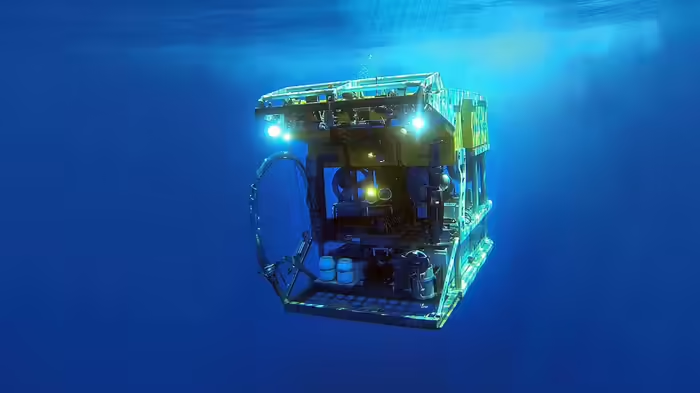
According to a report by Indian Defence Review, the real hero of this expedition is the Kiel 6000, a remotely operated vehicle (ROV) developed by Germany’s GEOMAR Institute.
Key capabilities include:
- Operational depth: 6,000 meters, accessing over 90% of the world’s ocean floor.
- High-definition cameras for crystal-clear images and video, even in pitch-black conditions.
- Two powerful robotic arms capable of collecting rock, water, and gas samples.
- Seven electric thrusters that allow smooth movement in any direction.
- A fiber-optic cable linking it to the ship for real-time control and data transfer.
- Stability features enabling it to remain steady even in strong underwater currents.
Kiel 6000 allows scientists to explore extremely dangerous depths without risking human life.
A Hydrothermal Field Unlike Any Other
The robot found something extraordinary at Karambuseil:
- Super-hot water (up to 51°C) and cold methane gas (3–20°C) emerging just 30–40 cm apart — a phenomenon never documented before.
- Methane concentration above 80%, the highest ever recorded in any hydrothermal system.
- Absence of typical “chimney-style” vents; instead, fluids were escaping directly from cracks in volcanic rocks.
This unusual combination indicates a highly active and unique geological environment.
A Hidden Ecosystem Revealed
The robot’s cameras captured thousands of deep-sea organisms thriving in complete darkness.
Scientists identified 23 species that appear to live exclusively in this region.
These organisms survive not on sunlight, but on chemical energy produced from hot water and methane — a food chain powered by geology, not solar energy.
This ecosystem may offer clues about how life began on Earth, and possibly on other planets.
Traces of Gold and Silver Found
Kiel 6000 also retrieved rock samples containing remnants of gold, silver, and other precious metals.
The findings suggest that millions of years ago, intense hydrothermal activity created natural mineral deposits in the area. Even today, volcanic heat is still active beneath the sea floor.
Interestingly, this mysterious hydrothermal field lies right in front of a major commercial gold mine on land. Some companies are reportedly eyeing the region for deep-sea mining — a prospect that alarms scientists.
A Fragile World at Risk
Researchers warn that any industrial mining in the region could destroy this rare ecosystem forever.
The discovery underscores how many secrets still lie hidden in the ocean depths — and how fragile such unique environments are.
Discover more from SD NEWS agency
Subscribe to get the latest posts sent to your email.