Patna:
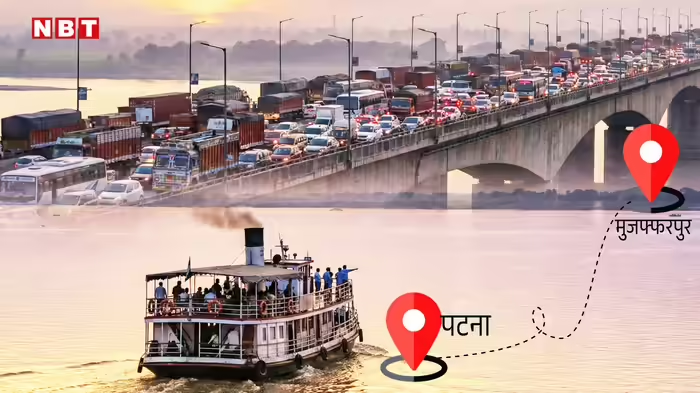
Long before traffic jams turned the Mahatma Gandhi Setu into a daily ordeal, the Ganga river itself served as Bihar’s most reliable highway. For decades, river transport was not just an alternative but the backbone connecting North and South Bihar—making journeys smoother, cheaper, and often more pleasant than today’s congested road travel.
The relevance of this forgotten legacy has resurfaced with the Union Budget 2026 announcement of a Ship Repair Centre in Patna, aimed at reviving inland water transport and boosting trade and commerce in Bihar. The move evokes memories of a time when Patna stood as a major hub of river navigation.
Until the construction of the Mahatma Gandhi Setu in 1982, steamers and river vessels on the Ganga were the primary mode of transport linking Patna with Sonpur, Hajipur, Muzaffarpur, Chhapra, Samastipur, Darbhanga and even Champaran. The bustling Mahendru Ghat and Bans Ghat once witnessed massive crowds of passengers boarding railway-operated and private steamers.
A Journey Etched in History
Even Mahatma Gandhi himself travelled by steamer during his visit to Bihar in 1917 for the Champaran Satyagraha. After alighting at Bankipur (Patna) railway station, he travelled by river steamer to Pahleja Ghat, from where he proceeded by train to Sonpur and then to Muzaffarpur. Gandhi stayed in Muzaffarpur for four days at Acharya J.B. Kripalani’s residence before heading to Champaran by road.
At that time, river transport was the only dependable link to North Bihar. Private steamers operated mainly from Bans Ghat near Golghar, owned by prominent local landlords, while railway steamers ran regularly between Mahendru Ghat and Pahleja.
Steamers with Canteens, Bookstalls and Memories
The river vessels of the 1970s were more than just transport—they were experiences. Some were double-decker steamers, equipped with canteens and bookstalls similar to railway stations. Passengers sipped tea, read newspapers, and browsed novels by authors ranging from Premchand to Gulshan Nanda while floating gently over the Ganga’s waves.
The journey from Mahendru Ghat to Pahleja took about one hour and fifteen minutes, followed by a short walk across sandbanks to reach Pahleja Junction. Tickets for river crossings and onward destinations were issued directly at Mahendru Ghat, making the system seamless and commuter-friendly.
When Trucks Sailed Across the Ganga
River transport wasn’t limited to passengers alone. During the British era, the LTC (Landing Tank Craft) Ghat—used by the Royal Navy during World War II—served as a crucial port. Even after Independence, massive steamers ferried loaded trucks, cars, motorcycles and heavy goods across the river.
Government employees transferred to districts like Gopalganj or Motihari often transported their entire household by loading trucks onto these vessels. The sight of huge ships carrying multiple trucks felt, as many recall, “like mountains floating on water.”
From Blissful River Travel to Bridge-Induced Gridlock
The completion of the Mahatma Gandhi Setu in 1982 led to the gradual shutdown of steamer services. What was once celebrated as an engineering marvel soon became synonymous with chronic traffic jams, pollution and commuter distress. A journey that once took minutes by steamer now often stretches into hours on the bridge.
Where river crossings were affordable and stress-free, road travel today is costly and exhausting. Transport experts reiterate a well-established fact: inland waterways remain the cheapest and most sustainable mode of transport.
As Bihar looks to revive its riverine past through renewed policy focus, many believe that the Ganga—once a lifeline—may again offer relief from congestion and restore a lost chapter of efficient, humane travel.
Discover more from SD NEWS agency
Subscribe to get the latest posts sent to your email.