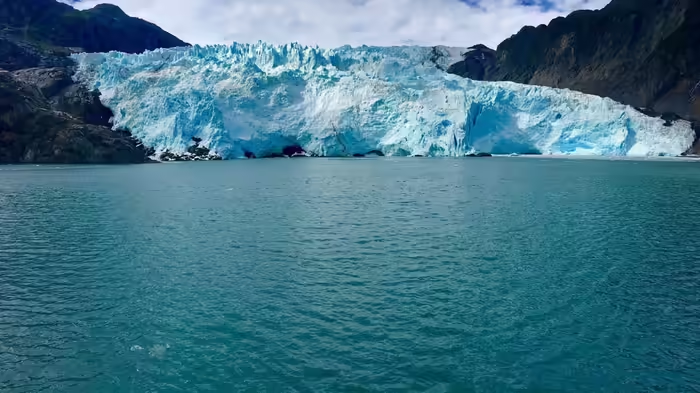
Srinagar, Jammu & Kashmir: A new study has sent alarming warnings about the vulnerability of Kashmir’s glacial lakes, which are at high risk of sudden and devastating Glacial Lake Outburst Floods (GLOFs). Experts say that rapid glacial melting due to climate change and pollution has created a series of glacial lakes across the Kashmir Himalayas, making the region increasingly prone to catastrophic flooding events.
The research, published in the prestigious Journal of Glaciology, was conducted jointly by the International Glaciological Society and the University of Cambridge, with lead contributions from Kashmir University’s Department of Geoinformatics. The study, funded by India’s Ministry of Earth Sciences (MoES), assessed current and future GLOF risks in the Indian Himalayas using satellite data and advanced modeling techniques.
Why the Warning Matters:
The study highlights that sudden outbursts from these glacial lakes could severely impact downstream communities and critical infrastructure. Kashmir’s largest glacier, Kolahoi, is melting rapidly due to rising temperatures and high levels of pollution. Glaciers near Thajiwas, Hokser, Nehnar, Shishram, and Harmukh are also gradually retreating. The resulting glacial lakes pose significant threats, filling voids left by melting glaciers and destabilizing the surrounding terrain.
Unprecedented Threats:
Experts note that rising winter temperatures, reduced snowfall, and intense summer heatwaves have accelerated glacial melting, creating lakes in areas that were previously stable. These conditions make communities and infrastructure increasingly vulnerable to hazards previously unseen in the region. Historical GLOF events, including the 2023 South Lhonak Lake disaster in Sikkim, which claimed over 100 lives, underscore the dangers of ignoring early warning signals.
Key Findings:
Led by Associate Professor Syed Danish Rafique Kashani, the study found a 26% increase in glacial lakes along snowbound glaciers between 1992 and 2024. This rapid formation of lakes corresponds to one of the fastest retreating glacial zones in the Himalayas. Researchers assessed lakes using ten risk factors, including dam composition, slope stability, seismic activity, permafrost melting, and upstream water accumulation.
Kashani noted that while the highest GLOF risk is currently concentrated in the central Himalayas, projections suggest a threefold increase in risk across the western Himalayas by the end of the century. Lakes like Bramsar and Chirsar are described as “time bombs,” showing rapid water accumulation due to melting glaciers.
Areas at Risk in Kashmir:
Several downstream areas are particularly vulnerable. Nundkol and Gangbal lakes in Ganderbal district threaten over 1,000 buildings, four bridges, and a hydroelectric plant. Bramsar and Chirsar lakes in South Kashmir’s Shopian and Kulgam districts endanger more than 400 buildings and five bridges, while Bhagsar Lake in Shopian puts over 1,100 structures and six bridges at risk.
Action and Solutions:
The research team is already working on practical solutions, including low-cost, early-warning systems specifically designed for Himalayan glacial floods. Community workshops and awareness programs are planned in vulnerable districts to improve preparedness.
Lead researcher Irfan Rashid emphasized, “As glaciers retreat due to rising global temperatures, Kashmir’s majestic peaks are creating hidden hydrological hazards. Science has now exposed these threats, and decision-makers can no longer ignore them.”
This study serves as a critical roadmap for authorities, urging evidence-based preventive measures to safeguard lives, infrastructure, and livelihoods in the fragile Himalayan region.
Discover more from SD NEWS agency
Subscribe to get the latest posts sent to your email.