Dehradun:
The Uttarakhand government has introduced stringent penal provisions under the amended Uniform Civil Code (UCC), making forced marriages and live-in relationships punishable with imprisonment of up to seven years. The amendment ordinance has received the approval of Governor Lieutenant General Gurmit Singh (Retd.), significantly tightening the legal framework governing personal relationships in the state.
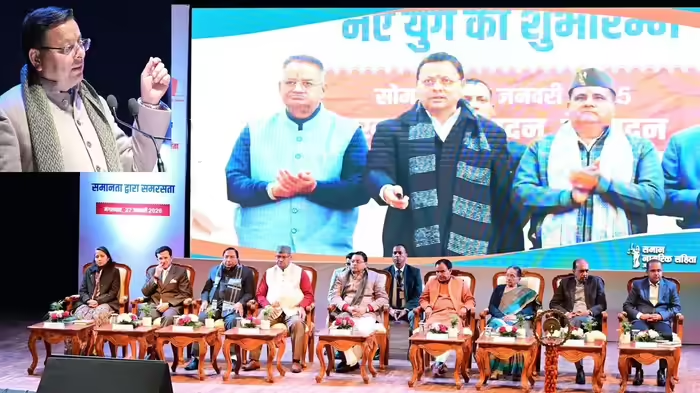
Uttarakhand became India’s first full state to implement the Uniform Civil Code on January 27, 2025, under the leadership of Chief Minister Pushkar Singh Dhami. One year after its implementation, the government has carried out major revisions following a comprehensive review of the law’s functioning.
Forced Relationships Now a Serious Criminal Offence
Under the amended provisions, any person found guilty of using force, coercion, pressure, or deception to enter into a marriage or live-in relationship can face up to seven years of imprisonment. The ordinance also criminalises cases where a married individual enters into another marriage or a live-in relationship without obtaining a lawful divorce, prescribing the same maximum punishment.
Punishment for Multiple Live-in Relationships and Minor Involvement
The amendment further states that entering into a second live-in relationship while already being in one will also attract a jail term of up to seven years. In cases involving a live-in relationship with a minor, an adult offender may face up to six months of simple imprisonment, a fine of up to ₹50,000, or both. Failure to pay the fine will result in an additional one month of imprisonment.
Concealment of Identity Made Punishable
Providing false information or concealing facts, including identity, religion, or marital status, to enter into a marriage or live-in relationship has been made punishable under the Bharatiya Nyaya Sanhita (BNS). This move comes amid rising concerns over cases involving deception to lure individuals into relationships.
Additionally, abetment, coercion, or inducement to violate mandatory conditions before remarriage has also been criminalised, carrying up to three years of imprisonment and a fine of ₹1 lakh. In case of default, offenders may face an additional six months in jail.
Illegal Divorce and Administrative Reforms
The ordinance provides for up to three years’ imprisonment and a fine in cases of illegal or fraudulent divorce, while child marriage cases will continue to be governed by the Prohibition of Child Marriage Act, 2006.
On the administrative front, the amendments designate the Additional Secretary as the competent authority under Section 12, replacing the earlier post of Secretary. If a Sub-Registrar fails to act within the stipulated timeframe, cases will now be automatically escalated to the Registrar and Registrar General. Provisions for appeals against penalties imposed on Sub-Registrars have also been introduced, and fines will be recoverable as land revenue.
Marriages Based on False Identity to Be Declared Void
The concealment of identity at the time of marriage has now been recognised as a valid ground for annulment. Registrars have been empowered to issue termination certificates upon the end of a live-in relationship. The amendments also grant the Registrar General the authority to cancel registrations related to marriage, divorce, live-in relationships, and succession.
Objective of the Amendments
Official sources stated that the changes were made after reviewing the implementation of the UCC over the past year. The primary objective is to clarify provisions, enhance effectiveness and practicality, strengthen administrative efficiency, and ensure better protection of citizens’ rights.
Further implementation guidelines are expected to be issued in the coming days.
Discover more from SD NEWS agency
Subscribe to get the latest posts sent to your email.