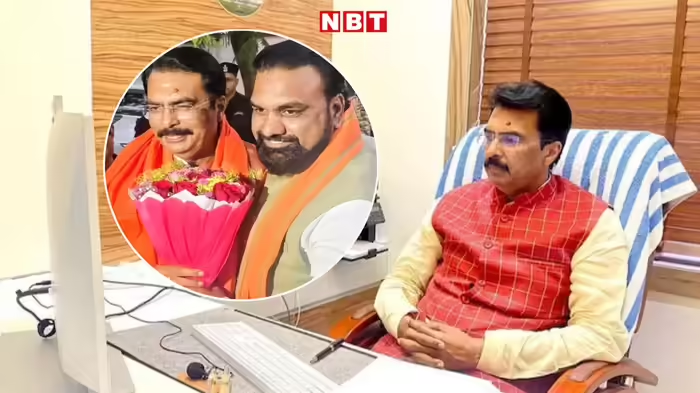
The Bharatiya Janata Party (BJP) is once again drawing attention with a surprise organisational decision in Bihar. Soon after Nitish Nabin was appointed to a key national organisational role, the party named Sanjay Saraogi as the new Bihar BJP State President—a move that has sparked intense political discussion. Contrary to widespread speculation, party insiders indicate that this appointment is driven not by caste arithmetic, but by Saraogi’s proven organisational capability.
With Saraogi taking charge, the BJP’s organisational strength in Darbhanga has visibly consolidated. Political observers note that this consolidation is not rooted in traditional caste-based vote-bank calculations. In fact, Saraogi belongs to the Vaishya community, and within it, to a sub-group that does not command a dominant standalone vote share. Yet, this is his greatest strategic strength.
Beyond Caste Calculations
The BJP has earlier appointed state presidents from diverse social backgrounds—Brahmin leaders like Mangal Pandey, Yadav leader Nityanand Rai, and Kushwaha leader Samrat Choudhary. Saraogi is the third Vaishya leader to hold the post, following Dilip Jaiswal and Sanjay Jaiswal. Analysts point out that the Vaishya community, taken collectively, accounts for nearly 20 percent of Bihar’s population, making it numerically stronger than several other major social groups. However, its political strength has often remained fragmented.
The BJP’s strategy appears to focus on unifying Vaishya sub-groups through organisational cohesion, rather than relying on narrow caste identities. Saraogi’s rise reflects this broader social consolidation approach, supported by the party’s core voter base and the combined political influence of Prime Minister Narendra Modi and Chief Minister Nitish Kumar, particularly among Extremely Backward Classes (EBCs).
Organisational Strength as the Deciding Factor
The most decisive factor behind Saraogi’s elevation is his exceptional grassroots management skills. A six-time MLA from Darbhanga Sadar, he has consistently won elections despite shifting political alliances and changing electoral equations. His success is widely attributed to his command over booth-level management, worker coordination, and deep understanding of cadre motivation.
In the Mithilanchal region—often described as politically complex and socially entrenched—Saraogi’s organisational discipline stands out as a rare example of effective party-building. BJP strategists believe that the party now requires organisers rather than orators, leaders who can strengthen the structure from the booth to the state level.
A Bigger Test Ahead
Party insiders describe Saraogi as a “leader of workers,” someone who understands the emotional and practical concerns of the cadre and translates them into electoral strength. By appointing him as state president, the BJP has provided him with a wider platform to replicate his Darbhanga model across Bihar.
Political observers see the 2029 Lok Sabha elections as the ultimate litmus test of Saraogi’s organisational abilities. His performance in strengthening the BJP’s structure statewide will determine whether this bold organisational bet delivers long-term political dividends.
For now, the message from the BJP’s high command is clear: effective organisation, not caste identity, is the key to leadership in Bihar politics.
Discover more from SD NEWS agency
Subscribe to get the latest posts sent to your email.