Patna:
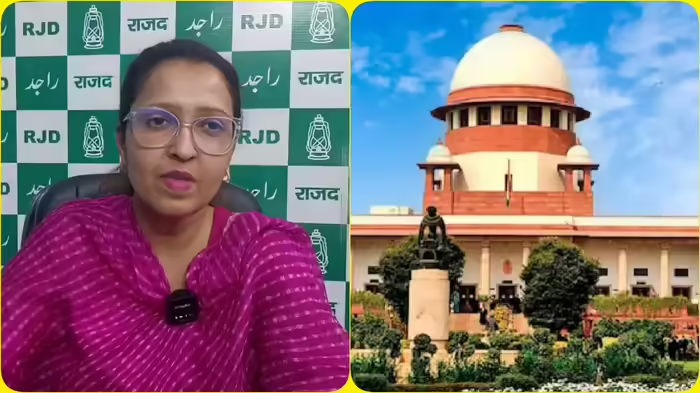
The political storm over the UGC Promotion of Equity Regulation 2026 intensified on Thursday after Rashtriya Janata Dal (RJD) spokesperson Sarika Paswan launched a fierce attack on the BJP-led central government, calling the regulation a “deliberate election gimmick” aimed at misleading Dalits and backward communities.
Reacting sharply to the Supreme Court’s stay on the regulation, Paswan accused the Modi government of surrendering before what she described as the country’s “dominant 10 per cent elite class.”
“This outcome was inevitable. In this country, economic, social and political power still rests with a privileged 10 per cent, and the government ultimately bows before them,” she said.
‘A Bill Meant to Mislead the Marginalised’
Terming the UGC regulation a “well-planned political drama,” the RJD leader said she had anticipated from the very beginning that the proposed rules would not survive.
“The BJP brought this bill in the name of Dalits and backward classes only to create an illusion. It was never meant to be implemented,” Paswan said.
She alleged that the move was strategically timed ahead of the Uttar Pradesh and West Bengal assembly elections, where large populations of Dalit and OBC voters play a decisive role.
“Sometimes they polarise society in the name of religion, sometimes in the name of temples. Now they tried it in the name of social justice,” she added.
‘Election Agenda, Not Social Reform’
Paswan dismissed the nationwide protests and political uproar over the regulation as “mere theatrics.”
“Those who truly intend to implement reforms do not create such noise. This entire controversy was an election agenda. Inside, everyone knew nothing would actually happen,” she claimed.
According to her, the BJP attempted to project itself as a champion of the marginalised to conceal what she called its “real ideological face.”
“Ninety per cent of this country consists of Dalits and backward communities. Yet policies are still dictated by the same powerful minority,” she said.
Anger Directed at Dalit and OBC Representatives
In a rare and scathing internal critique, the RJD spokesperson also expressed anger toward Dalit and backward-class MPs and MLAs.
“When reservation or representation is discussed, many of our own representatives fall silent. They enjoy the benefits but hesitate to speak when it truly matters,” Paswan said.
Calling this silence “deeply unfortunate,” she said real empowerment would remain incomplete without strong political participation and fearless voices from marginalised communities.
Serious Allegations of Institutional Discrimination
Expanding her criticism beyond politics, Paswan made sweeping allegations about systemic discrimination in higher education and competitive examinations.
She claimed that many students from Dalit and backward communities perform exceptionally well in written examinations but are deliberately filtered out during interviews due to the dominance of a particular social group in selection panels.
She further alleged that students are intentionally failed or delayed academically to prevent them from becoming doctors or engineers on time.
“Even hostel mess systems in premier institutions remain under the control of a specific section. In IITs, how many Dalit or backward-class individuals manage mess committees? The answer is close to zero,” she claimed.
‘A Centuries-Old Conspiracy’
Describing educational exclusion as a “centuries-old conspiracy,” Paswan said denial of education has long been used as a tool to maintain social dominance.
“This is not a new fight. It is historical, structural and deeply rooted. Our struggle against this discrimination will be long, but it will not stop,” she declared.
UGC Regulation Turns Into Major Political Flashpoint
With strong reactions emerging from both ruling and opposition camps, the UGC Regulation 2026 has now transformed from an education reform proposal into a major political flashpoint, intertwining issues of caste, power, representation and upcoming elections.
Political observers believe the debate will continue to shape narratives in Bihar and beyond, especially as the country heads toward crucial electoral battles.
Discover more from SD NEWS agency
Subscribe to get the latest posts sent to your email.