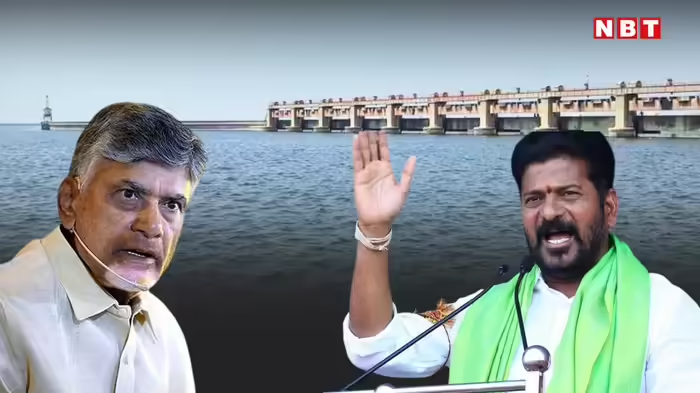
The long-standing river water dispute between Telangana and Andhra Pradesh escalated sharply on Tuesday as the two Telugu-speaking states clashed before the Supreme Court over the sharing of Godavari river waters. Telangana accused Andhra Pradesh of misusing its share of water through the proposed Polavaram–Nallamala Sagar Project (PNSP), while Andhra Pradesh strongly refuted the charge, calling the allegations politically motivated.
The matter came up before a Bench headed by Chief Justice Suryakant, along with Justice Joymalya Bagchi, where heated arguments were exchanged by senior counsels representing both states.
Telangana, led by Chief Minister A. Revanth Reddy, alleged that Andhra Pradesh was proceeding with the PNSP project despite a high-level committee constituted by the Centre—under the chairmanship of the Central Water Commission (CWC) chief—advising against moving forward. Appearing for Telangana, senior advocate A.M. Singhvi urged the court to stay the tender process for preparing the Detailed Project Report (DPR), arguing that the project would adversely affect Telangana’s allocated share of Godavari waters.
Singhvi contended that Andhra Pradesh’s claim of utilising “excess flood water” was misleading, as there was no scientific mechanism to accurately measure such surplus flows. He alleged that nearly 200 TMC (thousand million cubic feet) of water allocated to Telangana was being diverted under this pretext. He further stated that Telangana was entitled to use 968 TMC of water and had been constructing multiple barrages to fully utilise its share. The issue, he said, had become a major emotional and political concern in Telangana, as the project could significantly reduce the state’s water availability.
On the other hand, Andhra Pradesh Chief Minister N. Chandrababu Naidu appealed for cooperation between the two states to resolve all pending issues, including water sharing, through mutual consensus. Representing Andhra Pradesh, senior advocates Mukul Rohatgi, Jaideep Gupta and Balbir Singh told the court that the project had received Telangana’s consent at the time of the bifurcation of the erstwhile Andhra Pradesh.
Rohatgi argued that the current tender was only for preparing the DPR of an irrigation project aimed at utilising surplus flood water flowing through Andhra Pradesh, which is a lower riparian state. He emphasised that the project was intended to supply water to drought-prone regions and that the DPR work was being undertaken only after approval of the pre-feasibility report.
Jaideep Gupta questioned the basis of Telangana’s objections, asking whether one state could prevent another from executing an irrigation project located downstream. He also remarked that Telangana had already retained Hyderabad as its capital after bifurcation, implying that Andhra Pradesh should not be further constrained in pursuing development projects.
During the hearing, the Supreme Court raised a key legal question on whether a writ petition filed by a state was maintainable when the core issue involved inter-state river water dispute implementation, which also concerns Karnataka and Maharashtra. The Bench asked Singhvi to seek instructions within a week on whether Telangana would prefer to invoke Article 131 of the Constitution by filing an original suit, making Andhra Pradesh, Karnataka and Maharashtra parties to the dispute.
The case underscores the deepening fault lines between the two states over Godavari water sharing, with legal, political and emotional dimensions now converging at the country’s highest court.
Discover more from SD NEWS agency
Subscribe to get the latest posts sent to your email.