
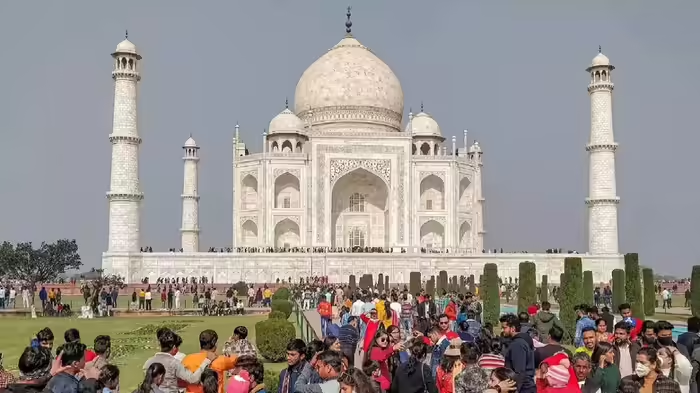
Agra, UP: The controversy over the Taj Mahal has resurfaced, with a petition claiming that the world-famous monument is actually the Tejo Mahalay Shiv temple. The case came up for hearing on Friday at the Agra court, where petitioner Ajay Tomar requested permission for ritual worship, including jalabhishek (water pouring) and dugdhabhishek (milk pouring), at the alleged temple during the month of Sawan.
Court Proceedings
During the hearing, the court considered arguments on whether Muslim parties should be allowed to intervene in the case. Tomar’s lawyer, Shiv Adhar Singh Tomar, urged the court to reject the plea of Syed Ibrahim Hussain Zaidi to become a party to the case, arguing that Zaidi had no concrete grounds for participation. Zaidi’s lawyer, Raisuddin, requested time to present his arguments and sought copies of the petitioner’s submissions. The court scheduled the next hearing for February 23, 2026.
Claims by Ajay Tomar
Petitioner Ajay Tomar asserted that Zaidi should not be made a party as he lacks evidence. He added that Zaidi, a former head of the Urs Committee, was attempting to delay proceedings by seeking party status. On September 23, 2024, Zaidi had claimed in court that the Taj Mahal is a Waqf Board property, prompting objections from Tomar on October 7, 2024. The Archaeological Survey of India (ASI) also filed objections on November 27, 2024, confirming the Taj Mahal is under ASI’s care.
Background of the Dispute
Tomar claims that the Taj Mahal was originally the Tejo Mahalay Shiv temple, built by King Parmardidev between 1155 and 1212. Later rulers, including Kings Man Singh and Jai Singh, reportedly preserved the temple while converting parts into a palace. Tomar alleges that during the Mughal era, Shah Jahan seized it and declared it Mumtaz Mahal’s tomb. The petition emphasizes that Tejo Mahalay has been a center of faith for millions of Hindus, seeking legal recognition for religious worship at the site.
Discover more from SD NEWS agency
Subscribe to get the latest posts sent to your email.