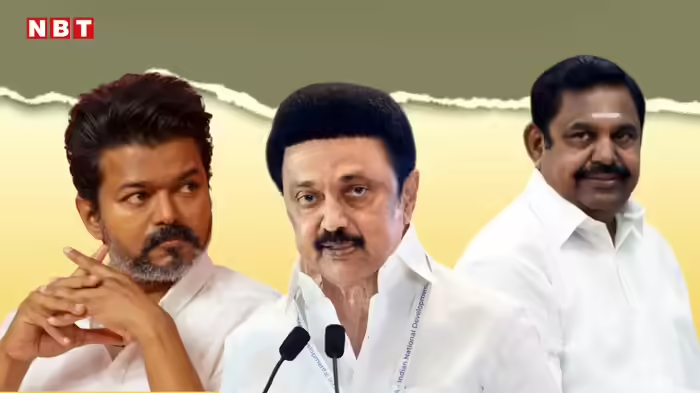
As Tamil Nadu gears up for its assembly elections, a high-stakes triangular contest is taking shape. The ruling DMK, led by Chief Minister M.K. Stalin, faces off against the AIADMK-led NDA, while actor Vijay’s newly launched party, TVK, is emerging as a formidable third force. Vijay’s political entry is testing the dominance of traditional “freebies politics” that has long shaped the state’s electoral outcomes.
When Vijay campaigns under the yellow flag and “bell” election symbol of TVK, massive crowds of young voters and women gather to cheer him. The energy evokes memories of the star power of M.G. Ramachandran (MGR) and J. Jayalalithaa. Yet, in his first electoral outing, Vijay faces the dual challenge of DMK’s generous welfare schemes and AIADMK’s cash-and-freebie promises.
DMK’s Cash and Freebie Advantage
Before the election was officially announced, CM Stalin’s DMK had already initiated a series of cash transfers and freebies aimed at winning voter loyalty. In January, the government disbursed ₹3,000 and Pongal gift baskets to 2.22 crore ration cardholders. Under the Ulagam Ungal Kayil scheme, 20 lakh government college students began receiving laptops. Additionally, ₹5,000 was deposited into the accounts of 1.31 crore women beneficiaries. Stalin has promised to double monthly payouts to women from ₹1,000 to ₹2,000 if DMK returns to power.
These measures specifically target young and female voters, overlapping significantly with Vijay’s core fan base.
AIADMK’s Counter Move
The AIADMK has responded with similar pledges, promising laptops for youth and ₹2,000 monthly payments for women. While Vijay has also promised ₹2,000 per month for women, his party has not yet revealed a comparable slate of freebies.
In Tamil Nadu, voter behavior historically balances admiration for star charisma with the appeal of tangible cash-and-freebie benefits. Previous superstar politicians, including Kamal Haasan, Vijayakant, Sivaji Ganesan, and Rajinikanth, have struggled to convert fame into electoral success, highlighting the entrenched influence of welfare-based politics.
The Legacy of Freebies in Tamil Nadu
DMK and AIADMK have long relied on freebies to win elections. In 2006, Karunanidhi secured a landslide victory for DMK by promising color TVs and subsidized rice, spending over ₹3,600 crore from the state treasury. In 2011, Jayalalithaa’s AIADMK countered with free mixers, grinders, laptops, school uniforms, 20 kg of rice, and cable TV, ultimately winning 203 of 234 seats.
Since then, the trend has expanded: DMK’s 2016 manifesto promised milk at ₹7 per liter, while Jayalalithaa offered subsidized loans, Amma Canteens, free electricity units, two-wheeler subsidies for women, and gold schemes for eligible brides. These initiatives cemented freebies as a central tool in Tamil Nadu politics.
Vijay’s Challenge
If actor Vijay can successfully challenge the DMK-AIADMK cycle of freebie-driven politics, it could mark the beginning of a new political era in Tamil Nadu. The coming months will test whether star power alone can rival decades of welfare-based electoral strategy in one of India’s most politically dynamic states.
Discover more from SD NEWS agency
Subscribe to get the latest posts sent to your email.