
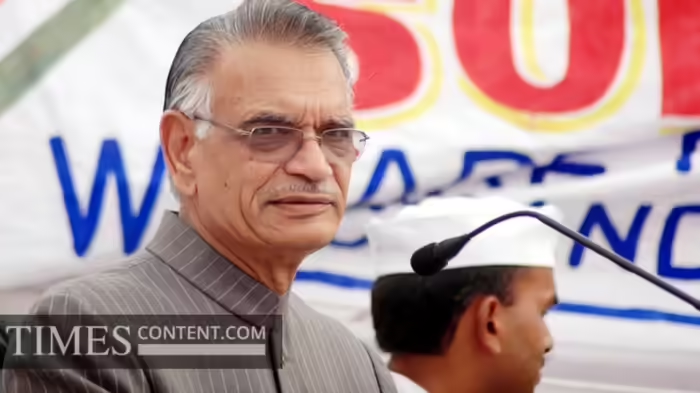
Senior Congress leader and former Union Home Minister Shivraj Patil passed away early Friday morning at his residence Devghar in Latur, Maharashtra. He was 91 and had been suffering from age-related ailments. Patil is survived by his son Shailesh Patil, daughter-in-law Archana (a BJP leader), two granddaughters, and a married daughter.
Patil, who held several top positions including Home Minister (2004–2008), Lok Sabha Speaker (1991–1996), and Defence Minister, was regarded as one of Congress’s most influential leaders. His political journey was long and decorated, though often accompanied by controversy.
Early Life & Education
Born on October 12, 1935, in Chakur village of the erstwhile Hyderabad State (now Maharashtra), Shivraj Patil graduated in Science from Osmania University. He later pursued law at Bombay University.
Entry Into Politics
Patil began his political career in 1967. With support from leaders Keshavrao and Manikrao Sonawane, he contested from Latur for the first time. A member of the Panchamashali Lingayat community, he became an MLA from Latur twice between 1972 and 1980, and held several important positions including Deputy Speaker and Speaker of the Maharashtra Assembly.
Seven-Time Lok Sabha MP
In 1980, Patil was elected to the Lok Sabha from Latur and went on to win seven consecutive elections until 1999. His only major electoral loss came in 2004 when he was defeated by BJP candidate Rupatai Patil Nilangekar—an outcome attributed partly to a wave of sympathy votes.
Trusted by Indira, Rajiv, and Sonia Gandhi
Patil served as Minister of State for Defence under Indira Gandhi, later holding independent charge of Commerce. He went on to lead key portfolios such as Science & Technology, Atomic Energy, Electronics, and Space.
Under Rajiv Gandhi, he handled Personnel and Defence Production, and later Civil Aviation and Tourism.
After Sonia Gandhi became Congress President, Patil held prominent organisational roles and played a central role in policy formulation. He is also credited with instituting the Outstanding Parliamentarian Award in 1992.
Some political observers even believe that had he not lost the 2004 Lok Sabha election, he might have been a strong contender for the post of Prime Minister.
Controversial Tenure as Home Minister
Patil’s tenure as Union Home Minister was marred by criticism over several security failures. His handling of the 2008 Mumbai terror attacks became the most controversial phase of his career.
During the attacks, Patil reportedly changed clothes multiple times before attending key security meetings—an act that sparked nationwide anger and led to harsh comparisons with “Nero,” accused of fiddling while Rome burned. Reports later revealed he had changed outfits three times within two hours.
Patil eventually resigned under mounting pressure following severe criticism from U.S. diplomatic circles and Indian political leadership.
Accusations Over Nandigram Violence
Facing allegations of delaying the deployment of central forces in Nandigram despite repeated requests, Patil was blamed for failing to prevent the law-and-order breakdown that led to civilian casualties.
His name was also discussed as a potential Presidential candidate in 2007, but Left parties opposed him, leading the Congress to nominate Pratibha Patil instead.
‘Gita and Jihad’ Comment Sparked Uproar
In 2022, Patil triggered another major controversy by drawing parallels between teachings in the Bhagavad Gita and Jihad. Though he later clarified that his reference was directed at Duryodhana in the Mahabharata, the remarks drew widespread criticism.
A Powerful Yet Polarising Figure
With a career spanning nearly six decades, Shivraj Patil leaves behind a legacy marked by stature, influence, achievements—and misjudgments that often overshadowed them.
Discover more from SD NEWS agency
Subscribe to get the latest posts sent to your email.