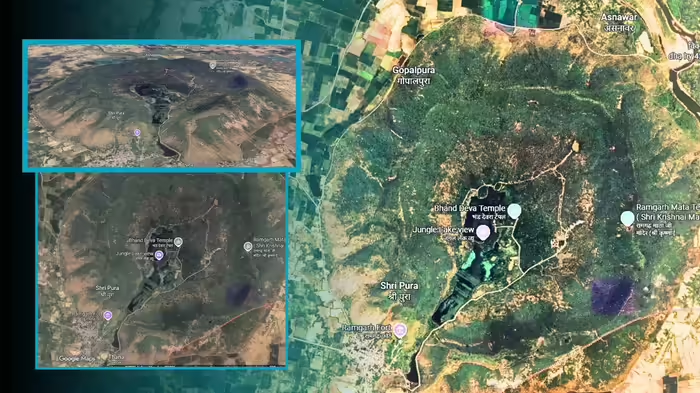
Baran, Rajasthan: The ancient Ramgarh Crater in Baran district of Rajasthan has once again become the focus of scientific study, revealing new insights into its 650-million-year-old origins. Recent research has uncovered microscopic magnetic particles within the crater, shedding light on the nature of the celestial impact that created it.
Key Highlights:
- New discoveries from a 650-million-year-old crater
- Evidence points to meteorite fragments
- Presence of iron and nickel detected
- Scientific significance of Ramgarh Crater heightened
Microscopic Magnetic Particles Discovered
Scientists collected soil samples from two shallow pits within the Ramgarh Crater near Ramgarh village. Approximately 30 samples were analyzed, with minute magnetic particles extracted using advanced magnetic separation techniques. Microscopic and chemical analyses of these particles revealed that many were smaller than a millimeter, with smooth, spherical surfaces. Researchers believe these particles formed when rocks melted and were ejected into the air during the meteorite impact, cooling rapidly to solidify.
Identification of Micrometeorite-Like Particles
The particles resemble micrometeorites — tiny, glassy fragments formed under the extreme heat of meteorite impacts. Chemical tests revealed the presence of iron, nickel, and silicon. The detection of nickel is particularly significant, as it is commonly found in meteorites but rare in the local sandstone formations of the Ramgarh region.
Indications of Iron-Rich Meteorite
Some particles also contained high concentrations of iron and iron-rich mineral structures, strengthening the possibility that they are remnants of the meteorite itself. These findings suggest that the Ramgarh Crater was likely formed by the impact of an iron-rich meteorite.
Scientific Significance
Scientists emphasize that this study provides compelling evidence of an iron-rich meteorite impact at Ramgarh. Such collisions often vaporize the meteorite, making direct evidence difficult to find. The discovery not only enhances our understanding of meteorite impacts on Earth but also offers valuable insights into the history of our solar system. Researchers hope that further studies will provide more precise information about the timing of the impact and the composition of the meteorite.
The findings were presented at the Lunar and Planetary Science Conference (LPSC) 2026, highlighting Ramgarh Crater as a key site for understanding ancient cosmic events on Earth.
Discover more from SD NEWS agency
Subscribe to get the latest posts sent to your email.