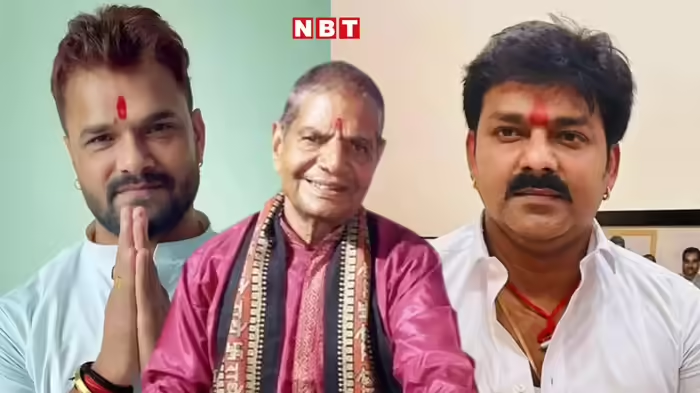
Patna: Renowned Bhojpuri folk singer, composer, and cultural icon Bharat Singh Bharti, recently honoured with the Padma Shri, has once again drawn attention to the declining quality of contemporary Bhojpuri music. In a candid interview given a few years ago, Bharti had openly stated that he does not listen to popular singers Pawan Singh and Khesari Lal Yadav, citing a lack of artistic and cultural depth in their songs.
Often described as a true son of Bhojpuri soil, Bharat Singh Bharti is regarded as one of the finest exponents of Bhojpuri folk music. Even at nearly 90 years of age, his dedication to music remains unwavering. “Music is my soul. I wish to be singing even at the moment of my death,” he once said, reflecting his lifelong devotion to the art.
Bharti is the lyricist of several iconic Bhojpuri songs, including the famous wedding song “Sanwar Sanwar Suratiya Tohar Dulha”, sung by legendary singer Sharda Sinha. His own most popular rendition, “Anguri Mein Dansle Biya Naginia Re, Ae Nandi”, continues to resonate with lovers of folk music.
A Deep Artistic Bond with Sharda Sinha
The late Sharda Sinha held Bharat Singh Bharti in the highest regard, treating him like an elder and mentor. Their association began after their first meeting at a music programme in Bokaro. Impressed by Bharti’s singing, Sharda Sinha invited him to her home in Samastipur, where both artistes spent days immersed in musical practice. Bharti would accompany on the tabla while Sharda Sinha rehearsed, and at times, their roles would reverse.
While Sharda Sinha achieved greater commercial success—receiving the Padma Shri in 1991, Padma Bhushan in 2018, and Padma Vibhushan posthumously in 2025—Bharat Singh Bharti’s contribution to Bhojpuri music remained equally profound. His Padma Shri recognition finally came in 2026, acknowledging decades of selfless service to folk culture.
“Today’s Songs Are Not Worth Listening To”
When asked whether he listens to contemporary Bhojpuri stars like Pawan Singh and Khesari Lal Yadav, Bharti replied bluntly, “No, I don’t. If something is not worth listening to, why should I listen to it?” He expressed deep anguish over what he termed the deliberate marginalisation of Bhojpuri’s rich linguistic and cultural heritage.
“Vulgarity is being served for quick money. The situation is such that four generations can no longer sit together and listen to Bhojpuri songs. This is an insult to the language,” he remarked.
Music Should Be Rich in Emotion and Culture
Reflecting on earlier times, Bharti said that songs of his era carried a sweetness that deeply moved listeners. He fondly recalled artistes like Vindhyavasini Devi, Kumud Akhauri, and Sant Raj Singh Ragesh, whose songs were rooted in literature, tradition, and emotional depth. “In those days, music was a form of spiritual practice. Entertainment never came at the cost of culture,” he said.
Bharat Singh Bharti’s words serve as a powerful reminder of the responsibility artists carry in preserving the soul of regional languages and folk traditions—especially at a time when commercial success often overshadows cultural integrity.
Discover more from SD NEWS agency
Subscribe to get the latest posts sent to your email.