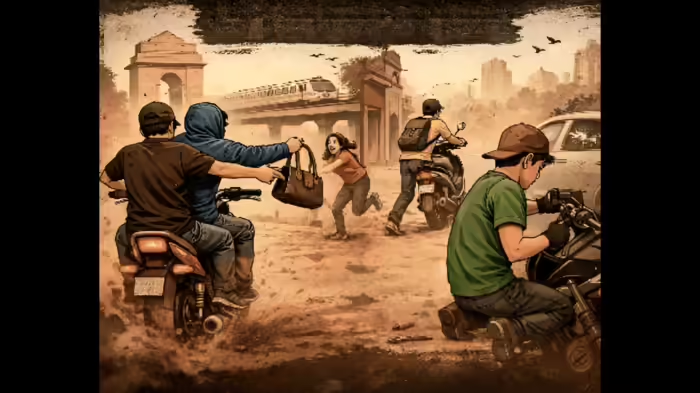
New Delhi: The increasing involvement of minors in criminal activities in the national capital has emerged as a serious cause of concern for law enforcement agencies. According to police officials and recent crime analysis, organised crime networks and gangsters are increasingly targeting juveniles, using them for drug supply, liquor delivery, gambling operations, extortion and, in some cases, even murder.
The alarming trend suggests that street crime is no longer limited to petty theft and snatching, but is rapidly turning into a gateway for minors to enter large criminal syndicates.
From Snatching to Gang Networks
Police data reveals that many juveniles begin their criminal journey with minor offences such as theft, snatching, and street violence. Over time, they are absorbed into organised gangs and become part of larger criminal operations.
Authorities say that the narrow lanes of Delhi’s older localities as well as outer colonies have witnessed a sharp rise in juvenile-driven crimes in recent years.
Sharp Rise in Crime Cases Involving Minors
A comparative study of crime statistics from 2024 and 2025 indicates a disturbing rise in juvenile crime cases. Reports show:
- Assault cases increased by 99
- Theft and burglary cases rose by 65
- Cases registered under IPC/BNS provisions were 6,050 higher in 2025 as compared to 2024
However, cases under the Arms Act, NDPS Act, Excise Act, and Gambling Act reportedly witnessed a slight decline in 2025.
How Juveniles Get Trapped in Gang Culture
Police officers believe that most juveniles involved in crime come from economically weaker families. Many have dropped out of school, while others are exposed to substance abuse at an early age.
Officials say that social media also plays a significant role in influencing minors. Criminal gangs often lure them by offering a false sense of “brotherhood,” showcasing power, money, luxury lifestyle, and easy access to resources.
Lured with Money, Clothes and Phones
According to police sources, the recruitment pattern is almost systematic. Initially, juveniles are attracted with food, clothing, mobile phones and quick cash. Soon, they are assigned tasks such as delivering alcohol, supplying drugs, operating betting rackets, or acting as messengers for gang members.
Once juveniles are caught once or twice and are released quickly under juvenile laws, their fear of legal consequences reduces significantly. Gangsters exploit this loophole, using minors as a “safe investment” and as the front face of violent operations.
Small Hands, Big Crimes
In earlier years, juveniles aged 14 to 16 were mostly involved in phone snatching and vehicle theft. But police now report a dangerous shift — many juveniles are increasingly involved in armed robberies, extortion shootings, and contract killings.
In several cases, juveniles are used as shields, while adult gang leaders operate from behind the scenes.
Cases Reaching the High Court
Recently, the Delhi High Court heard a case involving a woman accused of using a minor to supply liquor. In another shocking case, the sensational murder incident at GTB Hospital in 2024 also involved juveniles.
Police sources confirm that several juveniles have been arrested in recent years for involvement in firearms supply, drug distribution, illegal liquor trade, and extortion-related firing incidents.
Juvenile Crime: A Long-Standing Pattern in Delhi
The use of minors in organised crime is not new. Police records suggest that the trend has existed for decades. Notorious gangster Shakti Naydu from Ambedkar Nagar allegedly brought young boys from Chennai to commit crimes in Delhi.
In Madangir, a minor-led group became widely known as the “Baccha Gang.” In 2015, the gang carried out a sensational firing inside Karkardooma Court premises in front of a judge. The target survived, but a head constable lost his life in the incident.
Recent Murders Involving Minors Raise Alarm
Several brutal crimes in recent weeks have highlighted the rising role of minors in violent offences.
- February 2, 2026: A 22-year-old man, Arun, was stabbed to death in Acharya Niketan, Mayur Vihar. Three minors were arrested.
- February 9, 2026: A youth was stabbed to death by five minors in DLF Park, Moti Nagar, after an argument over standing in the park.
- January 22, 2026: A murder case in Preet Vihar linked to criminal money distribution saw four arrests, including three juveniles.
Police also recalled older cases where juvenile gangs were involved in major robberies, including a Mayur Vihar Phase-3 jeweller’s house robbery and a high-profile Lajpat Nagar robbery case in 2014.
Juvenile Gangs Operating Across Delhi
Authorities have identified several juvenile gangs operating across Delhi, often using weapons to carry out robberies and street violence. These gangs reportedly record videos of crimes and upload them on social media to establish dominance and fear.
In many cases, gang rivalry has also resulted in murders. Police officials say several gang leaders have either grown into adult criminals and landed in jail or remain in juvenile correction homes.
Investigators believe that some of these gangs are being used by major criminal networks, including those linked to notorious gangsters, for extortion and targeted shootings.
Some of the prominent juvenile gangs reportedly active in Delhi include:
- Mastaan Gang (Seelampur)
- Maya Gang (Bhajanpura)
- Makoka Gang (Welcome)
- Allu-Anas Gang (Jafrabad)
- Chaudhary Gang (Welcome)
- Shooter Gang (Jwala Nagar, Shahdara)
- MJ Gang (Anand Parbat)
- 78 Gang (Patel Nagar)
- Sarkar Gang (Baljeet Nagar)
- Bhagat Singh Group (Baljeet Nagar)
- Anas Gang (Jahangirpuri)
A Growing Threat to Society
The rising trend of juvenile involvement in organised crime has become a major challenge for Delhi Police. Experts warn that unless urgent social reforms, strict monitoring, counselling, and stronger rehabilitation programs are implemented, street crime may continue to remain the first step for minors entering the world of serious criminal activities.
The issue has also reignited debate over how juvenile offenders are being exploited by criminal gangs due to lenient legal provisions and quick bail under juvenile justice laws.
Discover more from SD NEWS agency
Subscribe to get the latest posts sent to your email.