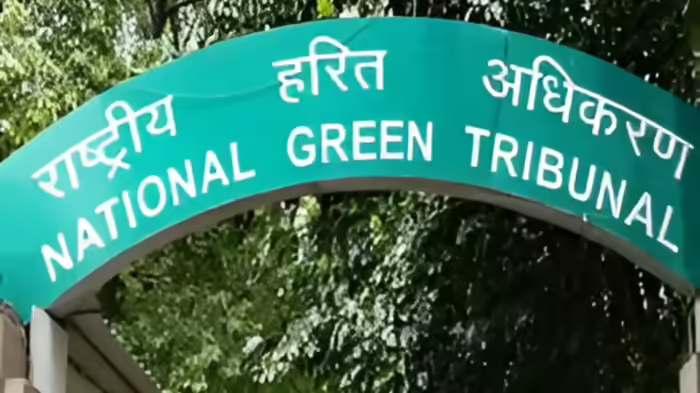
New Delhi: In a significant move to restore the population of indigenous fish in the Yamuna River, the National Green Tribunal (NGT) has directed the Central Pollution Control Board (CPCB) to take concrete steps. The order comes in response to declining numbers of native fish species, particularly in the stretch between Delhi and Mathura.
NGT Issues Directive
The Principal Bench of the NGT, headed by Justice Prakash Srivastava along with expert member Dr. A. Senthil Vel, instructed that measures be taken to increase indigenous fish populations and control invasive species. A survey conducted by ICAR-CIFRI between 2020 and 2024 documented 126 fish species in the Yamuna. The report highlighted a decline in native species such as Katla, Rohu, Mahseer, and Eel.
Survey Reveals Impact of Pollution and Invasive Species
The study also found that foreign species like Common Carp, Nile Tilapia, and Thai Magur have increased in heavily polluted areas. The NGT noted that factors such as pollution, dam construction, habitat changes, overfishing, and climate change have contributed to this imbalance. The survey covered the stretch from Yamunotri to Prayagraj, confirming the presence of 126 species overall.
Delhi-Mathura Stretch Most Affected
The report identified the stretch between Delhi and Mathura, especially from Wazirabad to Okhla, as the most affected, with the lowest number of fish species. Only Magur fish were recorded in this heavily polluted section. The study observed that foreign species can survive in a wide range of conditions, while Magur fish can survive even in low-oxygen waters.
ITO Section of Yamuna Severely Polluted
The ITO area in Delhi has been identified as the most polluted part of the Yamuna, with near-zero water flow and oxygen levels. Interestingly, Nile Tilapia was first recorded in Prayagraj in July 2005. Its population grew from around 100 kilograms initially to 36.3 tonnes by 2010, and later to 10.13 tonnes and 25.28 tonnes in 2014 and 2015, becoming a dominant fish species in Delhi and Prayagraj.
The NGT’s directive emphasizes the need for urgent intervention to revive indigenous fish populations, restore ecological balance, and control invasive species in the river.