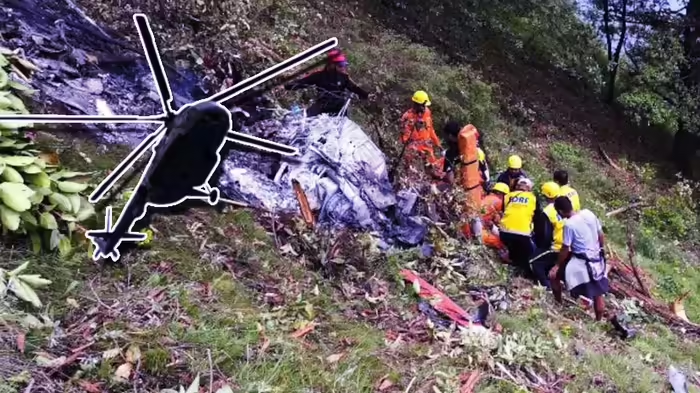
The haunting last words of the Aryan Aviation helicopter pilot, who perished in the Kedarnath crash on June 15, have come to light: “I can’t see anything, turning…” The tragic incident near Guptkashi claimed the lives of all seven people on board. The interim report by the Aircraft Accident Investigation Bureau (AAIB) confirms that the pilot’s statement reflected the sudden loss of visibility, which led to the helicopter colliding with a mountain during the first morning flight of the day.
The helicopter, registration VT-BKA, was scheduled for the first flight under the Uttarakhand Civil Aviation Development Authority (UCADA) slot system, which permits flights at sunrise. Retired Army aviator Captain Rajveer Singh Chauhan reached Guptkashi around 4:30 AM, underwent a breathalyzer test, reviewed the valley’s CCTV footage, and completed all pre-flight checks. The helicopter took off at 5:10 AM and reached Kedarnath in approximately ten minutes.
After disembarking passengers, the helicopter, carrying six people, began its return flight from Kedarnath. According to protocol, helicopters exiting the valley are required to maintain an altitude of 9,000 feet. The area is notorious for rapidly forming, unpredictable clouds.
Two other helicopters, VT-TBF and VT-TBC, were scheduled to follow VT-BKA. As the helicopter exited the valley, the pilot reported on the radio that clouds had formed in the path. Seconds later, his final words were transmitted: “Cannot see anything, turning…” No further distress calls were received, and the helicopter never returned to Guptkashi.
The pilot of VT-TBC later informed investigators that he heard the warning and opted to descend to avoid the cloud-covered area. CCTV footage from three valley cameras confirmed dense clouds at the exit point. Both helicopters following VT-BKA used lower-altitude routes to exit safely.
Local authorities were promptly informed that VT-BKA had collided with a mountain near Guptkashi. The crash resulted in a fire, killing all on board: Captain Chauhan; Badri-Kedar Temple Committee representative Vikram Rawat (45); Vinod Devi (66) and Trishti Singh (19) from Uttar Pradesh; and Rajkumar Jaiswal (41) from Maharashtra, along with his wife Shraddha (35) and their two-year-old daughter Kashi. Captain Chauhan’s wife serves as a Lieutenant Colonel in the Indian Army.
AAIB’s interim report highlights significant shortcomings in weather monitoring. While Kedarnath helipad has an automated weather instrument providing real-time data on wind, visibility, temperature, pressure, humidity, and dew point, it does not track cloud conditions—crucial in valleys prone to sudden cloud formation. No weather updates were shared in the operator’s WhatsApp group that morning, leaving the pilot reliant on CCTV footage for visibility checks.
The report also notes that the Kedarnath valley lacks a dedicated meteorological facility. UCADA staff periodically share live-feed screenshots with operators, but investigators deemed this system insufficient for safe operations.
Following the tragedy, the DGCA revised its 2023 circular on Kedarnath shuttle operations. The new regulations mandate a dedicated control center with an in-charge officer, ATC support, and IMD meteorological assistance, along with minimum flight times for each shuttle sector. The final AAIB report is awaited.
Discover more from SD NEWS agency
Subscribe to get the latest posts sent to your email.