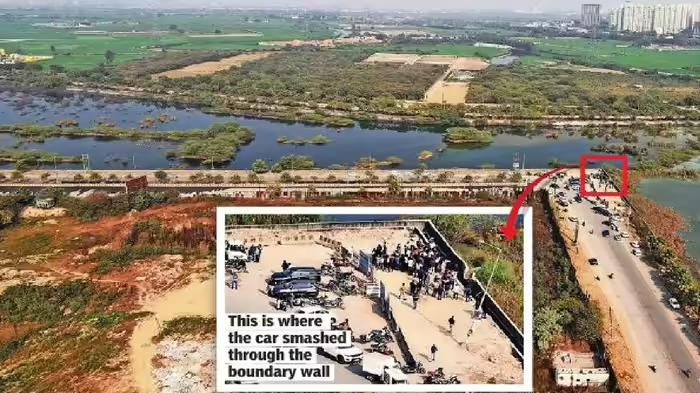
Noida: The tragic death of a 27-year-old software engineer in Noida has exposed serious lapses in planning and execution by civic authorities, raising troubling questions about infrastructure safety in what is often described as a “planned city.” The young tech professional, Yuvraj Mehta, drowned late Friday night after falling into a water-filled pit in Sector 150 — a site that had effectively turned into a stagnant pond due to years of administrative neglect.
The land where the incident occurred was originally allotted for a private mall project. However, for nearly a decade, it has remained undeveloped, accumulating rainwater and sewage discharged from nearby housing societies. What should have been a managed drainage zone instead became a hazardous water body, with no proper barricading or warning signs.
A Project That Existed Only on Paper
Documents from the Noida Authority reveal that as far back as 2015, the Irrigation Department had proposed the construction of a head regulator to divert excess rainwater into the Hindon River. In February 2016, the department received ₹13.5 lakh from the Noida Authority to conduct a survey and prepare a design for the regulator. Despite multiple site inspections and official communications over the years, the project failed to move beyond the planning stage.
A letter dated October 9, 2023, written by the Executive Engineer of the Irrigation Department’s Construction Division in Ghaziabad to the Senior Manager of Noida Authority’s Work Circle 10, highlights that repeated discussions had taken place between 2015 and 2023. These discussions stressed the urgent need to channel rainwater from developing sectors into the Hindon River.
The letter further states that the regulator’s design, prepared by a consultant, had even received approval from IIT Delhi. However, during a joint site inspection on October 4, 2023, Noida Authority officials suggested modifications, citing increased water flow due to additional sectors being connected to the existing drain. They recommended replacing the mechanical gate with a hydraulic or pneumatic gate.
Following this, the Irrigation Department sought an additional ₹30 lakh for a fresh survey, revised designs and updated hydrological data, including maximum discharge, water depth, unusual slopes and freeboard. The revised survey report, however, remains pending to date.
Monsoon Warnings Ignored
The consequences of this prolonged delay became starkly visible during the 2023 monsoon season, when Sector 150 and surrounding areas witnessed severe waterlogging. Basements of several housing societies — including those developed by ATS, ACE, Godrej, Tata, Eldeco and Samriddhi — were flooded as rainwater could not be discharged into the Hindon River in the absence of a regulator.
Residents were forced to use heavy dewatering pumps, while clogged drains caused sewage water to backflow into homes. The lack of a controlled outlet not only worsened flooding but also created dangerous conditions that ultimately proved fatal.
Action After Tragedy
It was only after the death of Yuvraj Mehta that authorities announced concrete action. Executive Engineer B.K. Singh of the Irrigation Department said that work on the head regulator would begin within a week. He stated that the estimated cost of the project is ₹10.5 crore, which will be financed by the Noida Authority.
According to Singh, the financial bid from the selected contractor has already been received, and remaining formalities — including submission of official documents and a security deposit — are expected to be completed within a week. The department now aims to finish the project before the onset of the next monsoon to minimize future risks.
He also explained that the project had gone through several stages over the past few years, including proposal drafting, approvals from the authority, scrutiny by a state-level committee and the tendering process. Final clearance was granted by the Chief Engineer Committee before bids were invited.
Residents Blame Official Apathy
Local residents have squarely blamed the Noida Authority for inaction. They argue that had the regulator been installed on time, water would not have accumulated on the low-lying commercial plot near the Hindon–Yamuna confluence.
Jitendra Meena, a resident of Tata Eureka Park, said that the regulator could have controlled water flow and adjusted excess water within the plot, potentially preventing the tragic accident. “If this basic infrastructure had been in place, a young life might not have been lost,” he said.
A Preventable Loss
The death of Yuvraj Mehta has become a grim reminder of how delayed decisions, bureaucratic inertia and poor coordination between departments can turn minor infrastructure gaps into life-threatening hazards. In a city promoted as a model of modern urban planning, the incident has sparked outrage and renewed calls for accountability, transparency and swift execution of long-pending public safety projects.
Discover more from SD NEWS agency
Subscribe to get the latest posts sent to your email.