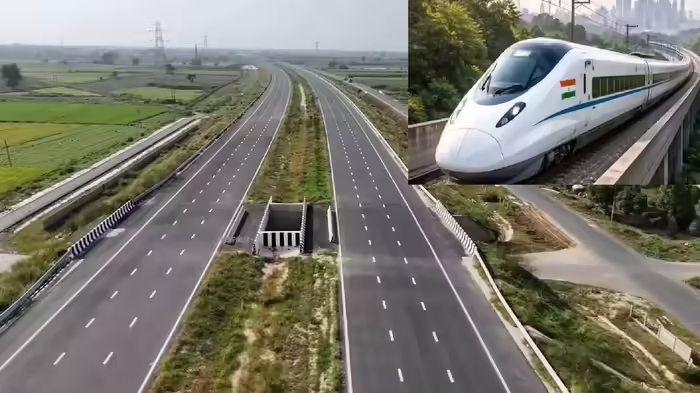
The Union Budget 2026–27, presented by the Modi government, has opened a new chapter of development for Uttar Pradesh, with a landmark proposal to expand the high-speed rail network across the state. The announcement is being seen as a game-changer, particularly for western and central Uttar Pradesh, as it promises seamless connectivity between expressways, airports and rail corridors, significantly reducing travel time and boosting economic activity.
Among the key highlights is the proposal for a Delhi–Varanasi High-Speed Rail Corridor, which is expected to directly benefit districts such as Meerut, Noida, Jewar, Mathura, Agra, Lucknow and Prayagraj. The corridor will also integrate with the Ganga Expressway, Uttar Pradesh’s longest expressway currently nearing completion.
Ganga Expressway and High-Speed Rail: A Strategic Link
The budget announcement has raised strong expectations that the Ganga Expressway Link Expressway, connecting Meerut to the Noida International Airport at Jewar, will be integrated with the high-speed rail corridor. This strategic linkage is expected to transform Meerut into a multi-modal transport hub, connecting road, rail and air networks at high speed.
The 594-kilometre-long Ganga Expressway, stretching from Meerut’s Bijauli to Prayagraj, is in the final stages of construction and is expected to be inaugurated soon. Once operational, it will dramatically cut travel time across the state. The proposed 74.30-kilometre Ganga Expressway–Noida Airport Link Expressway will further enhance connectivity for passengers and cargo.
Faster Travel, Stronger Economy
According to officials, trains on the Delhi–Varanasi high-speed rail corridor are expected to operate at speeds of up to 300 km per hour, reducing the current travel time of 10–12 hours to nearly 4–4.5 hours. This will significantly improve access to religious, cultural and commercial centres such as Haridwar, Mathura, Prayagraj, Varanasi and Hastinapur.
The improved connectivity is expected to give a major push to trade, tourism and industry, benefiting local businesses, exporters and pilgrims alike. Meerut’s sports goods and jewellery industries are also expected to gain from faster access to domestic and international markets via the Noida International Airport.
Noida Airport to Become a Key Transport Node
A high-speed rail station has also been proposed near the Noida International Airport at Jewar, making it one of the most strategically connected airports in the country. With direct access to the Yamuna Expressway, Ganga Expressway, Noida–Greater Noida Expressway and the high-speed rail network, the airport is poised to emerge as a critical logistics and passenger hub.
This integrated network is also expected to reduce traffic pressure on the Delhi–Meerut Expressway, offering alternative high-capacity routes for long-distance travel.
Expansion Plans: Ganga Expressway Phase-2
The government is also expected to move ahead with Ganga Expressway Phase-2, which proposes a 110-kilometre greenfield link expressway from Meerut to Haridwar, passing through the Muzaffarnagar–Roorkee route. This link will eventually connect to the Char Dham Highway, significantly easing travel for pilgrims heading to Uttarakhand.
A New Growth Corridor for UP
With the convergence of high-speed rail, expressways and an international airport, Uttar Pradesh is set to witness unprecedented infrastructure-driven growth. The budget’s focus on long-term connectivity projects is expected to generate employment, attract investment and strengthen tourism, firmly placing the state on the fast track to economic transformation.
Discover more from SD NEWS agency
Subscribe to get the latest posts sent to your email.