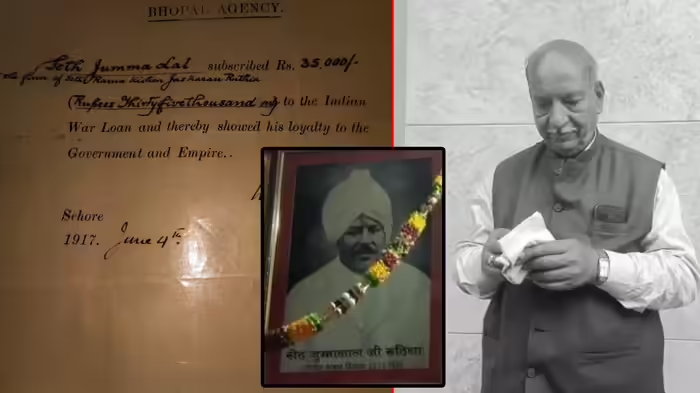
Sehore (Madhya Pradesh), February 23, 2026: In a remarkable case blending history, law, and legacy, the descendants of prominent Sehore-based businessman Seth Jumma Lal Ruthiya have initiated legal steps to recover a loan of ₹35,000 allegedly given to the British administration in 1917—an amount they claim would exceed ₹1 crore in present-day value.
According to family records, Seth Jumma Lal Ruthiya—once considered among the wealthiest individuals in the region after Sultan Jahan Begum of the erstwhile Bhopal State—extended financial assistance to the British government to help manage administrative affairs in the princely state.
Legal Notice to the British Crown
Vivek Ruthiya, grandson of the late Seth Jumma Lal, has announced that a formal legal notice is being sent to the British Crown, citing documented correspondence and financial records preserved within the family.
“The transaction was formal and documented. Under international legal principles, a sovereign nation remains liable for its historical debts,” Vivek Ruthiya asserted, adding that the principal sum of ₹35,000 in 1917 would translate to more than ₹1 crore today when adjusted for inflation and historical value.
Family members state that Seth Jumma Lal passed away in 1937, two decades after extending the loan. The original documents were reportedly discovered among the will and papers inherited by his son, Seth Manakchand Ruthiya.
Property Legacy and Ongoing Disputes
The Ruthiya family is said to have owned substantial land holdings across Sehore, Bhopal, and Indore. Local accounts suggest that nearly 40–45 percent of Sehore’s older settlements once stood on land belonging to the family. Several properties remain registered in their name, though some are allegedly under dispute or occupied by tenants paying nominal rents ranging from ₹100 to ₹500 under longstanding arrangements.
These property-related conflicts have further drawn attention to the family’s historic prominence and extensive land records.
Legal Experts Weigh In
Advocate G.K. Upadhyay noted that while a legal notice can indeed be served on the basis of documented correspondence, the enforceability of the claim would depend entirely on the original agreement’s terms—particularly clauses regarding repayment timelines, interest, and limitations.
“In financial agreements, the repayment period and conditions are clearly defined. If the time limit lapses, the subsequent legal standing depends strictly on the contractual terms,” Upadhyay explained.
Key Highlights of the Case
- Seth Jumma Lal Ruthiya was among the wealthiest businessmen of his time in Sehore.
- In 1917, he allegedly loaned ₹35,000 to the British administration.
- The amount remains unpaid more than a century later.
- His descendants are issuing a legal notice to the British Crown.
- The family claims the historical sum now exceeds ₹1 crore in present value.
As the notice is dispatched, legal observers say the case could raise complex questions about sovereign liability, historical financial obligations, and the interpretation of colonial-era agreements in modern international law.
Whether the claim results in a legal battle or remains symbolic, it has reignited interest in a century-old financial transaction that bridges India’s colonial past and its present-day legal framework.
Discover more from SD NEWS agency
Subscribe to get the latest posts sent to your email.