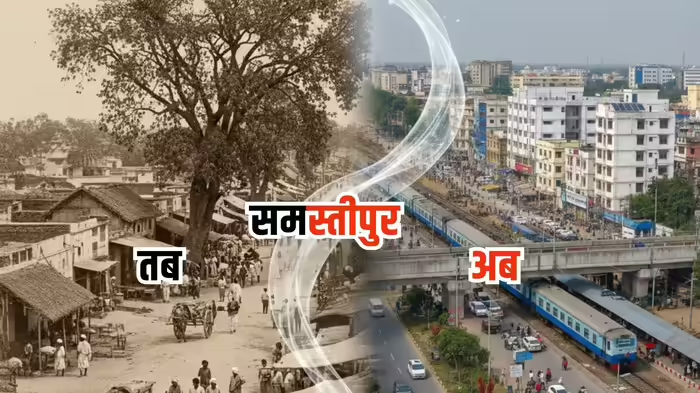
Samastipur, Bihar: Every city carries the rhythm of its own history, and Samastipur is no exception. With time, cities evolve—not just in infrastructure and culture, but often in name as well. The town now known as Samastipur was originally called Saraisa, with some sources suggesting its ancient name was Somvati, which later became Somvastipur, Samvastipur, and eventually Samastipur.
Historical Roots
Samastipur’s roots trace back to the Mithila kingdom under King Janak, whose dominion included present-day Samastipur. Following the end of the Videha dynasty, the region became part of the Licchavi republic and later came under the expansive empires of Magadh—Maurya, Shunga, Kanva, and Gupta dynasties. Chinese traveler Xuanzang’s accounts suggest that the region also fell under Emperor Harshavardhan’s empire.
In the 13th century, during the rule of Muslim ruler Haji Shamsuddin Ilyas of Bengal, Mithila and Tirhut regions were divided. The northern part came under the Oeinwar rulers of Sugouna (1325–1525 CE), while the southern and western portions were under Shamsuddin Ilyas.
From the 14th to 16th centuries, Samastipur was under the control of the Oeinwar rulers of Darbhanga, including kings like Kameshwar Singh and Shiv Singh, who are remembered for promoting art, culture, and literature. Dev Singh, Shiv Singh’s father, established Devkuli near Laheriasarai. Successors such as Padma Singh, Hari Singh, Narsingh Dev, Dheer Singh, Bhairav Singh, Rambhadra, Lakshminath, and Kamsanaryan left their mark on the city. Gold and silver coins issued during the reigns of Shiv Singh and Bhairav Singh remain valuable historical sources.
Colonial and Modern Era
During British rule, Samastipur was made a subdivision under the Tirhut division in 1865. Based on recommendations from the Bihar State District Reorganization Commission, it was declared a separate district under Darbhanga division on 14 November 1948. Today, Samastipur district comprises four subdivisions: Samastipur, Rosra, Dalsinghsarai, and Patori. Key blocks include Samastipur, Kalyanpur Pusa, Warisnagar, Tajpur, Khanpur, Sarairanjan, Ujiyarpur, Rosra, Singhiya, Hasanpur, Bithan, Vibhutipur, Shivajinagar, Dalsinghsarai, Patori, Vidyapatinagar, Mohiuddin Nagar, Mohanpur, and Morwa.
The Name Evolution
The current name “Samastipur” is believed to have originated during the reign of Shamsuddin Ilyas, the Muslim ruler of Bengal. The city’s evolution in name mirrors its rich and diverse history, from Saraisa to Samastipur, reflecting centuries of cultural, political, and social transformations.
Recently, during his “Samriddhi Yatra,” Bihar CM Nitish Kumar announced an investment of ₹827 crore in Samastipur, further highlighting the city’s growing importance while connecting its illustrious past with a promising future.
Discover more from SD NEWS agency
Subscribe to get the latest posts sent to your email.