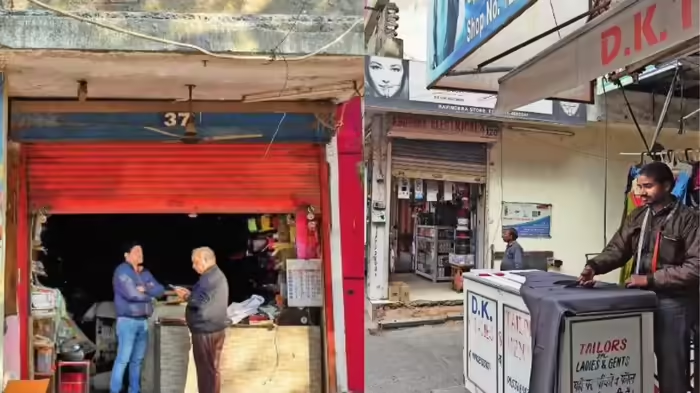
Once famous for its tailors and long queues of customers getting shirts and pants stitched, Meherchand Market in Delhi has now undergone a striking transformation. The bustling market, originally established by refugees after Partition, is gradually evolving into a modern shopping plaza where people now line up outside cafes instead of tailor shops.
A Market Born from Partition
Meherchand Market’s origins trace back to post-Partition Delhi. Refugees from Pakistan set up roughly 240 temporary stalls in Lodi Colony. By 1964, these were replaced with 152 permanent shops, officially christened Meherchand Market. The market became known as “Delhi’s Wonder Market”, where around 20 tailors worked together, rapidly altering clothes for customers. For decades, tailoring remained the market’s core identity.
A Shift Begins in 2022
The year 2022 marked a turning point. The South Delhi Municipal Corporation approved a redevelopment plan, converting Meherchand Market into a three-story, pedestrian-friendly modern shopping plaza. Old shops were demolished and rebuilt with uniform designs. Today, the market features glass-fronted showrooms, salons, and cafes. For instance, a shop that once rented tents and tarpaulins for weddings is now home to Carnatic Cafe, attracting long queues for its food.
Third-Generation Adaptation
Inderjit Singh, Vice-President of the Meherchand Market Association, says, “I have been here since the permanent shops were built. I belong to the second generation, and now the third generation is taking over. We welcomed Carnatic Cafe, and see how it draws crowds. This inspires others to adapt and evolve.”
Market President Ashok Sakhuja adds, “Who wouldn’t want to move forward? Customer demands have changed, rents are better, and we are evolving. Our goal is to place Meherchand Market in the league of Connaught Place, Hauz Khas Village, and Khan Market.”
Tailors Fade, Some Shops Close Permanently
Many of the original “Wonder Tailors” have retired or left. Dev Kumar (62) of D.K. Tailors recalls the early days, “Ready-made clothes weren’t common. People brought old clothes for alterations, like converting bell-bottoms to straight pants. Today, tailoring offers stable income but faces less competition.”
Some long-standing shops, like Shyam Book Depot (est. 1964), are shutting down as demand shifts online. Owner Anil Choudhary reflects, “People now order online. We must move forward and explore new opportunities.”
Adapting Instead of Resisting
Others have embraced change. Praveen Bhaskar’s family started with a tea stall and later moved to stationery. Today, Bhaskar Store exemplifies that survival in Meherchand Market has always depended on timely adaptation.
A Market Reimagined
Meherchand Market’s redevelopment has not erased its legacy but given it a new identity. The first phase post-Partition focused on survival, while the current evolution aligns with modern retail trends. Many hope it will become another GK or Khan Market, though challenges of time and investment remain.
Contrast with Khanna Market
A few kilometers away, Khanna Market retains its old charm. Basic upgrades—better roads, cleaner public spaces, improved facilities—have been made, but the essence of businesses remains unchanged. A shop selling freshly ground coffee still thrives, and New Madras Hotel continues serving its loyal customers. As one shopkeeper noted,
Discover more from SD NEWS agency
Subscribe to get the latest posts sent to your email.