R
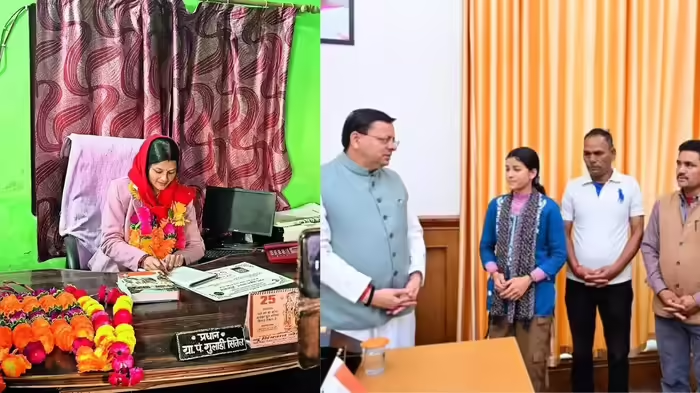
In the hills of Uttarakhand—where migration has hollowed out villages and tradition has long dictated leadership—a quiet but powerful revolution is unfolding. Fresh out of college, armed with degrees and smartphones, a new generation of village heads, many of them women in their early twenties, is stepping into grassroots politics with one clear mission: to rebuild their villages from within.
The recent Panchayat elections in Uttarakhand marked a turning point. Several young women won seats historically dominated by older men, challenging not just age-old hierarchies but also the deeply entrenched model of the “Pradhan Pati” that has long shadowed women’s leadership. For these Gen Z leaders, the Panchayat is not a stepping stone to power or prestige—it is a conscious decision to return home and serve.
Choosing the Village Over the City
Twenty-two-year-old Sakshi Rawat, a biotechnology graduate, could have easily found employment in a Dehradun laboratory. Instead, just three months after completing her degree, she returned to her village Kui in Pauri Garhwal to contest the Panchayat elections.
“Most young people leave the village after education,” Sakshi says. “I want them to stay here and build something of their own.” For her, Uttarakhand’s biggest challenge is not geography or lack of funds, but mindset. “People still believe success exists only outside the village. Real change will come when results are visible at home.”
Her leadership has already made a difference. By introducing a rainwater harvesting system through community participation, Sakshi helped address the village’s persistent water crisis—an intervention small in scale, but transformative in impact.
Governance Is the Real Mathematics
In Sarkot village of Chamoli district, 21-year-old Priyanka Negi is redefining what leadership looks like. Once aspiring to become a mathematician, Priyanka found her calling in governance during her graduation years.
“I’ve always loved numbers,” she says, “but I realized governance is the real mathematics.” Having accompanied her father—himself a two-time village head—to block-level meetings since childhood, Priyanka learned early how decisions shape lives.
Her priorities are sharp and pragmatic. “Fix the roads,” she says, “and half of the problems of hill life solve themselves.” Using her academic training, she prepared a detailed project report and successfully pursued government funding. Construction of a new road in her village has now begun, promising better access, connectivity, and opportunity.
Breaking Patriarchy at the Grassroots
At just 22, Diksha Mandoli, Pradhan of Gulari village in Chamoli, embodies resilience. Married at 20 and a mother by 21, Diksha is an English graduate who firmly rejects the outdated notion of proxy leadership.
“People now speak to us directly,” she asserts, dismantling the idea of male intermediaries in women-led Panchayats. Diksha has identified substance abuse among youth as a growing concern. In response, she has launched sports initiatives and skill-based livelihood programs, offering young people both purpose and direction.
Similarly, Kiran Negi, the youngest Pradhan in her block, leads the small village of Chari with just 250 voters. “The village may be small,” she says, “but the problems are not.” From roads to drinking water, Kiran is challenging the belief that ambition belongs only to cities.
Digital Leadership, Local Solutions
What truly sets these Gen Z leaders apart is their approach to governance. They actively use social media to connect with residents, share development plans, gather feedback, and ensure transparency—bringing an unprecedented level of digital engagement to village politics.
Their leadership style is participatory, tech-enabled, and result-oriented. It signals a decisive shift from symbolic representation to substantive power.
Architects of Uttarakhand’s Future
These young women are not merely addressing immediate village issues—they are reshaping the narrative of rural India. They demonstrate that leadership has no age, that governance can be inclusive and efficient, and that villages can be spaces of opportunity rather than departure.
With fresh ideas, technological fluency, and an unwavering commitment to their roots, Uttarakhand’s Gen Z Pradhans are not just village heads. They are architects of the state’s future—digital, determined, and decisively transformative.
Discover more from SD NEWS agency
Subscribe to get the latest posts sent to your email.