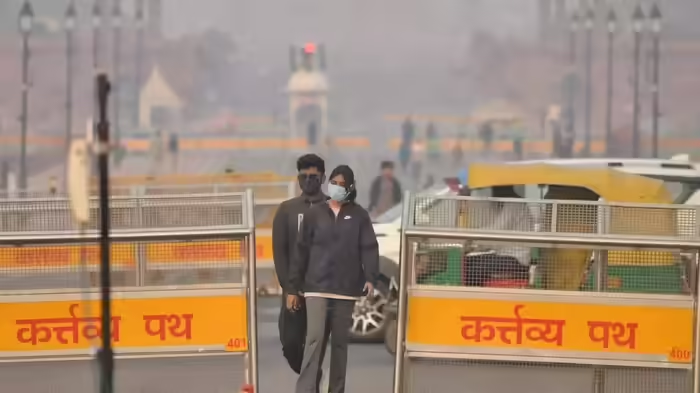
Delhi’s air quality deteriorated sharply after the lifting of GRAP-3 restrictions, with the city recording an AQI of 377. Several areas in the capital crossed the 400-mark, bringing back dense smog. Schools have reverted to offline classes, even as road repair work had earlier contributed to a 32% reduction in pollution in targeted zones.
Pollution Levels Surge Immediately
After the Commission for Air Quality Management (CAQM) removed GRAP-3 restrictions on Wednesday, pollution levels began to climb within 24 hours. Thursday saw the AQI rise further, though GRAP-3 will only be reinstated if levels reach between 401 and 450.
According to the Central Pollution Control Board (CPCB) air bulletin, the AQI in Delhi on Thursday stood at 377. Surrounding cities also reported high pollution: Faridabad 203, Ghaziabad 358, Greater Noida 381, Gurugram 317, and Noida 391. Smog is visibly returning across the region.
Local Hotspots
By 9 AM, Delhi’s AQI was 355, up from 327 the previous Wednesday when GRAP-3 was lifted. Some key local readings included: Anand Vihar 420, Ashok Vihar 407, Bawana 430, Chandni Chowk 411, DTU 409, Jahangirpuri 409, Mundka 427, Narela 405, Nehru Nagar 429, Punjabi Bagh 413, Rohini 433, Vivek Vihar 429, and Wazirpur 434. Forecasts suggest the city will remain in the “very poor” category from 25–30 November, potentially extending for the following six days. Wind speeds were recorded at just 5 km/h on Thursday.
Schools Return to Offline Mode
Following the lifting of GRAP-3 restrictions, Delhi schools have reverted from hybrid to fully offline classes. The Directorate of Education issued a circular revoking earlier hybrid-mode guidelines. The CAQM had removed GRAP-3 after three days of slight improvement in pollution levels.
Road Repairs Show Temporary Improvement
Research conducted by IIT Delhi in collaboration with DPCC revealed that road repair work led to a 32% reduction in localized pollution levels. However, just 50 meters away, pollution levels remained high. The study, led by Professor Sagnik Dey and Dr. Sophia, focused on areas like Jahangirpuri and Ashram to evaluate the impact of pothole repairs on air quality.
Weather Outlook
Delhi’s winter chill is expected to remain mild, with little variation in temperatures through the first week of December. Thursday recorded a maximum of 25.7°C (0.3°C below normal) and a minimum of 8.3°C (2°C below normal). The sky is expected to remain mostly clear, with occasional light clouds in the next two to three days.
Discover more from SD NEWS agency
Subscribe to get the latest posts sent to your email.