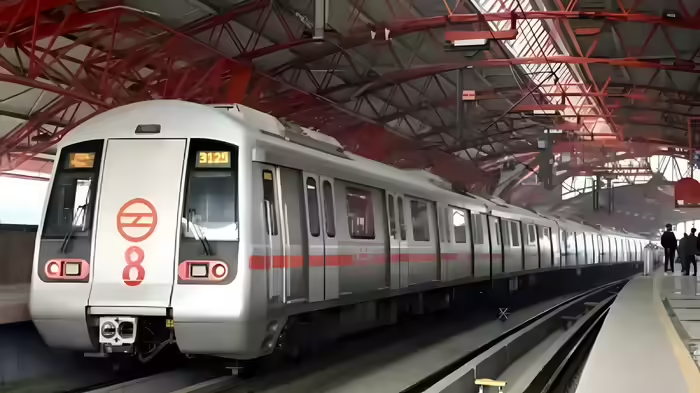
New Delhi: The Delhi Metro Rail Corporation (DMRC) is planning a new corridor to improve connectivity in East Delhi. A 13.19-kilometer metro stretch will connect Mayur Vihar Phase-3 to Shastri Park, enabling seamless integration between the Pink, Blue, and Red Lines.
DPR Submitted to Government
The DMRC has prepared the Detailed Project Report (DPR) for the Phase-5B corridor and submitted it to the Ministry of Urban Development and the Delhi government in October 2025 for approval. Once cleared by the central government, work will commence on the corridor, which aims to reduce road traffic by diverting thousands of daily commuters to the metro network.
Currently, passengers traveling from areas like Mayur Vihar Phase-2 and 3, Pandav Nagar, Laxmi Nagar, Gandhi Nagar, or Trilokpuri to Kashmere Gate must first take the Blue or Pink Line to Welcome Metro Station and then switch to the Red Line. With the new corridor, commuters will be able to travel directly from Mayur Vihar Phase-3 to Shastri Park, and onward to Kashmere Gate on the Red Line, saving time and reducing transfers.
Direct Connectivity for Dense East Delhi Areas
East Delhi neighborhoods such as Gandhi Nagar, Geeta Colony, and Mother Dairy currently lack direct metro access. Residents must rely on buses, RTVs, or e-rickshaws to reach nearby Blue or Pink Line stations. The new corridor will bring these areas directly into the metro network, making travel across Delhi easier and faster.
Three New Interchange Stations
The Phase-5B corridor will include three new interchange stations, connecting Mayur Vihar Phase-3, Shastri Park, and other lines. The new Nirman Vihar interchange station will enable smooth transfers between the Blue, Pink, and Red Lines, reducing travel time for passengers.
DMRC’s Long-Term Plan
Under Metro Phase-5, DMRC plans to construct 18 new corridors across Delhi-NCR, focusing on a global-standard metro network where every resident has a metro station within 400–500 meters of their home. All lines will be interconnected to allow easy access from one area to another. Approval has already been granted for three primary corridors in Phase-5A, and work is ongoing to secure clearance for the remaining 18 corridors in Phase-5B.
This expansion is expected to significantly improve connectivity, ease congestion, and make commuting across the capital more efficient for daily travelers.
Discover more from SD NEWS agency
Subscribe to get the latest posts sent to your email.