
Raipur:
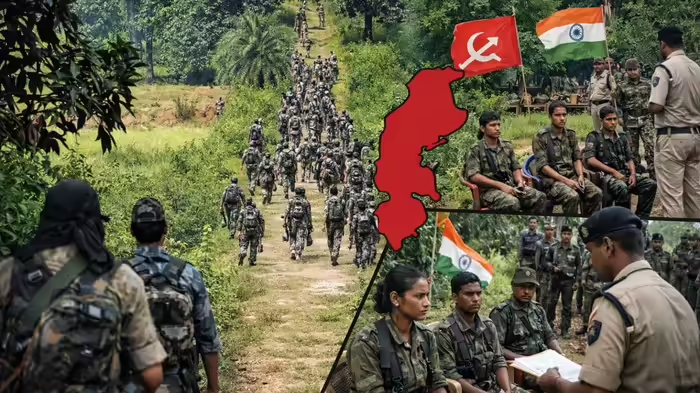
As the government’s deadline to eliminate Maoist insurgency from India by March 31, 2026 draws closer, security agencies are intensifying operations in Maoist-affected regions. While a large number of cadres have surrendered under the government’s rehabilitation policy, officials remain concerned that a handful of hardened leaders are still active in the forests, continuing to fuel insurgency.
In Bijapur district of Chhattisgarh, surrendered Maoists are now being trained in skills such as driving, tailoring, masonry, and other livelihood-based professions to help them reintegrate into mainstream society. The initiative is part of the government’s surrender-cum-rehabilitation programme, aimed at ensuring that former insurgents can rebuild their lives peacefully.
80 Maoists Undergoing Rehabilitation in Bijapur Camp
Officials said that a surrender camp in Bijapur currently houses 40 men and 40 women, who laid down arms in November 2025. These former insurgents, once living in armed groups deep inside jungles, are now provided food, shelter, and training facilities.
Along with vocational skills, the camp offers basic amenities such as electricity, television, internet access, sports activities, and recreational facilities, helping the surrendered cadres adapt to normal life.
Former Maoists Reveal Reasons Behind Joining the Movement
Many former cadres have shared that they joined the Maoist movement due to torture, exploitation, and harassment.
One former divisional commander, Maso Tamo (37), also known as Sameer, said he was pushed into insurgency after the Salwa Judum movement (2005) destroyed his village.
Similarly, a female cadre named Jogi Madhavi claimed she was wrongly implicated by police and jailed, which led her to join the Maoists. She is now learning tailoring and hopes to return to her family.
Authorities Fear Risk of Re-Radicalisation
Despite the success of surrender programmes, officials believe long-term de-radicalisation efforts are essential to prevent former Maoists from returning to insurgent activities.
Former commander Bodu Mohanda (34) stated that many Maoists surrendered due to a lack of leadership, continuous security operations, deaths of comrades, and old age. However, some younger cadres, particularly those around 20 years old, still believe jungle life was better and remain hesitant about surrendering.
Financial Assistance Kept Under Lock-in Period
Bastar Range IG Sundarraj P. said that a screening committee reviews each surrendered cadre’s case carefully. Financial assistance provided under the policy is kept under a three-year lock-in period to ensure that the money is not misused for Maoist activities.
After surrendering, individuals are kept in a transit camp for 1 to 3 months, where essential documents such as Aadhaar card, voter ID, and ration card are arranged.
Five Top Naxalite Leaders Still Active
Even as Maoist strength continues to weaken, intelligence agencies confirm that five major Naxalite leaders are still active and operating in forest regions. These include:
- Thippiri Tirupati alias Devji
- Muppalla Laxman Rao alias Ganapathi (former General Secretary)
- Misir Besra (Jharkhand in-charge)
- Malla Rajireddy alias Sangram
- Pappa Rao alias Mongu
According to IG Sundarraj, the CPI (Maoist) organisation is in a deteriorating condition, having lost public support. He noted that Maoists are increasingly targeting civilians in the name of informers and are involved in illegal extortion. Their safe shelters and strongholds are shrinking, and they have reportedly been unable to hold Central Committee meetings for a long time.
Security Presence Expanded in Maoist Zones
Security forces have strengthened their presence across Maoist-affected regions. Forward Operating Bases (FOBs), earlier set up within a 5-km radius, have now been expanded to cover 10 km.
In 2025 alone, 58 new FOBs were established, enabling Joint Task Forces (JTFs) to achieve major successes in Chhattisgarh, Jharkhand, Odisha, Maharashtra, and Madhya Pradesh.
What Lies Ahead?
Officials believe that after establishing peace in remote areas, permanent infrastructure such as police stations and long-term local deployments will be essential. Plans are underway to set up police stations between clusters of two to three camps, while also maintaining FOBs to prevent any resurgence of Maoist activities.
With the deadline approaching fast, security agencies remain focused on dismantling the remaining Maoist network and ensuring lasting stability in affected regions.
Discover more from SD NEWS agency
Subscribe to get the latest posts sent to your email.