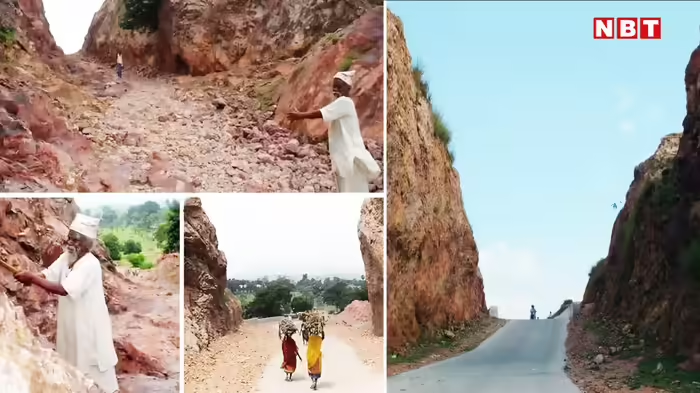
Gaya, Jan 14:
“Do not sit idle trusting God—who knows, God may be trusting us.” These words were not merely a line, but the philosophy of a man who proved that unwavering human resolve can humble even nature’s toughest barriers. On the birth anniversary of Dashrath Manjhi, famously known as the “Mountain Man,” India remembers a life that transformed personal tragedy into a timeless lesson of courage, perseverance, and social change.
Born on January 14, 1934, in Gehlaur village of Bihar’s Gaya district, Dashrath Manjhi belonged to the marginalized Musahar community and lived the life of a landless laborer. His name entered history not through privilege or power, but through sheer grit that reshaped an entire region.
A Tragedy That Changed Destiny
The turning point came in 1959, when Manjhi’s wife, Falguni Devi, slipped from a rocky hill while bringing him lunch and suffered fatal injuries. Although the nearest hospital at Wazirganj was barely 15 kilometers away, an imposing mountain forced villagers to travel nearly 70 kilometers. By the time Manjhi tried to take his wife for treatment, it was too late. That moment of loss gave birth to an extraordinary resolve. Standing before the mountain that had claimed his wife’s life, he made a vow: “I will not stop until I break this mountain.”
Twenty-Two Years Against a Mountain
In 1960, armed with nothing but a hammer and chisel, Manjhi began cutting through the ancient quartzite rock—some 1,600 years old. Villagers mocked him, calling him insane and broken by grief. But Manjhi followed a relentless routine: working as a laborer by day to earn his livelihood, and chiseling the mountain from afternoon till late night. When rocks proved too hard, he lit dry wood against them and poured water to crack the stone through heat and shock.
His hands bled, his feet were wounded, but his determination never wavered. After 22 years of solitary labor, by 1982, Manjhi had carved a passage 360 feet long, 30 feet wide, and 25 feet high. The once-deadly mountain now became a lifeline. The distance between Atri and Wazirganj shrank from 55 kilometers to just 15, bringing schools, hospitals, and markets closer to thousands.
Recognition Came Late
Ironically, while Manjhi carved a path with bare hands in just over two decades, it took the government many more years to lay a paved road on it. The route was finally asphalted in 2011—four years after his death on August 17, 2007. Posthumously, he was honored with the title “Bihar Ratna,” and a commemorative postal stamp was issued in his name.
A Legacy That Lives On
Dashrath Manjhi’s story reached a global audience in 2015 through the film “Manjhi: The Mountain Man,” directed by Ketan Mehta, with Nawazuddin Siddiqui delivering a powerful portrayal of his life. Today, Gehlaur stands not just as a village, but as a symbol of human will. A memorial and statue commemorate Manjhi, while organizations like the SBI Foundation support education and ambulance services in the area.
On his birth anniversary, Dashrath Manjhi’s life reminds the nation that faith is strongest when paired with action—and that even the mightiest mountains can bow before human determination.
Discover more from SD NEWS agency
Subscribe to get the latest posts sent to your email.