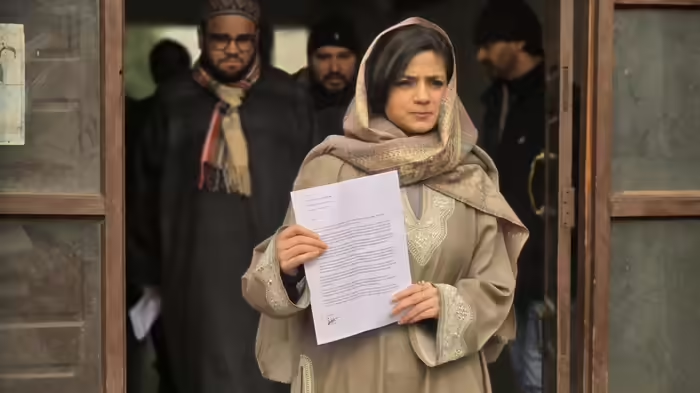
Srinagar, Jammu & Kashmir: A political controversy has erupted in Jammu and Kashmir after Iltija Mufti, daughter of former Chief Minister Mehbooba Mufti, stated that she will not be forced to chant nationalist slogans like “Bharat Mata Ki Jai” or “Jai Shri Ram.” Her remarks have drawn sharp criticism from the Bharatiya Janata Party (BJP), further intensifying the political climate in the Union Territory.
Iltija Mufti made the comments while expressing concern over restrictions on freedom of expression in the region. Her statement comes amid a controversy triggered by the Jammu and Kashmir police launching an investigation against a local cricketer who shared an image online wearing a Palestinian-flagged helmet.
Iltija Mufti’s Statement
Speaking on the matter, Iltija Mufti said,
“No one can force us to chant ‘Bharat Mata Ki Jai.’ We will not be compelled to follow your ideology. If you try to make us chant ‘Jai Shri Ram’ or ‘Bharat Mata Ki Jai,’ we will refuse.”
She questioned the state of free speech in Jammu and Kashmir, asking whether citizens are truly allowed to speak openly. She emphasized that expressing solidarity with Palestine should not be treated as a criminal act.
Allegations Against Governance
Iltija Mufti further compared the global protests against violence in Gaza with local policing in J&K. She claimed that in the region, people are being arrested over minor issues, VPNs are restricted, and governmental actions are being justified under the pretext of law. According to her, this effectively signals the collapse of law and order in Jammu and Kashmir.
BJP Demands Apology
Affiliated with the People’s Democratic Party (PDP), Iltija Mufti clarified that her stance opposes the forced use of nationalist slogans and the imposition of a specific ideology, not India or its citizens. However, the BJP retaliated, accusing her of insulting national sentiments and opposing Hindutva, and demanded a formal apology.
The incident has reignited a long-standing debate over patriotism, freedom of expression, and the distinction between dissent and anti-nationalism in India, particularly in the context of Jammu and Kashmir.
Discover more from SD NEWS agency
Subscribe to get the latest posts sent to your email.