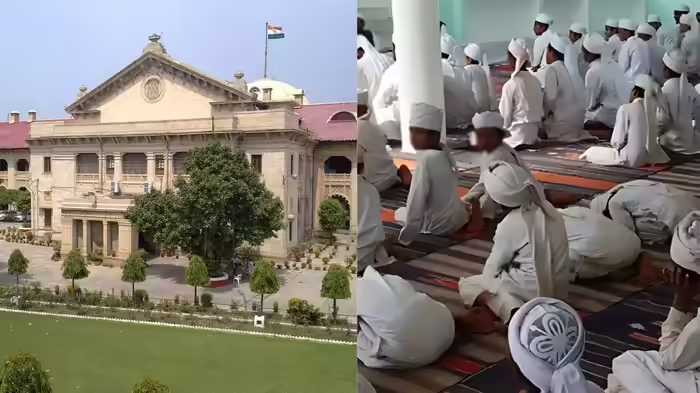
Prayagraj: In a significant judgment concerning unrecognised madrasas, the Lucknow Bench of the Allahabad High Court has ruled that a madrasa cannot be shut down solely on the ground that it lacks official recognition. The court directed the authorities to remove the seal from a madrasa in Shravasti district within 24 hours, providing major relief to thousands of similar institutions facing possible action.
The order was passed by a single-judge bench of Justice Subhash Vidyarthi while hearing a petition filed by the management of Madrasa Ahle Sunnat Imam Ahmed Raza, Shravasti. The madrasa had been sealed by the district administration on the ground that it was operating without recognition. The madrasa management challenged the order of the District Minority Welfare Officer, Shravasti, which had directed its closure.
No Rule to Shut a Madrasa Only for Lack of Recognition
The High Court observed that there is no provision in the relevant rules that authorises the closure of a madrasa merely because it is unrecognised. “There is no such rule in the applicable regulations that permits stopping the operation of a madrasa only on the basis of non-recognition,” the court noted.
Accordingly, the court quashed the order of the District Minority Welfare Officer and held that sealing the madrasa only on the ground of lack of recognition was not supported by law. The bench made it clear that, in the absence of a specific legal provision, such administrative action cannot be sustained.
State’s Argument Rejected
During the hearing, the state government had argued that allowing an unrecognised madrasa to function could create problems for students in the future, particularly regarding the validity of their education and qualifications. However, the court found that this concern, by itself, was not sufficient to justify the closure of the institution without a clear statutory basis.
Warning for Madrasa Operators
Legal experts believe that the ruling strikes a balance between the freedom to impart education and adherence to government regulations. At the same time, it also serves as a caution for madrasa operators.
The court clarified that unrecognised madrasas can function only as private institutions. They will not be entitled to recognition from the Madrasa Board, and their students’ degrees will not be considered valid for government jobs. Such institutions will also not be eligible for any form of government grant or financial assistance.
No Board Exams, No Government Benefits
In addition, the Madrasa Education Board will not be bound to allow students from such institutions to appear in board examinations. Qualifications obtained from these madrasas cannot be used to claim any benefits or entitlements linked to the state government.
The court observed that while these institutions are free to operate without recognition, it is ultimately the responsibility of madrasa managements to meet the prescribed सरकारी मानक and obtain official recognition at the earliest to safeguard the future of their students.
A Precedent-Setting Judgment
The ruling is being seen as a landmark decision for unrecognised madrasas across Uttar Pradesh, many of which had been under the threat of closure in recent months. By affirming that non-recognition alone is not a valid ground for sealing an institution, the Allahabad High Court has set an important legal precedent, while also underlining the practical limitations faced by such madrasas unless they regularise their status.
Discover more from SD NEWS agency
Subscribe to get the latest posts sent to your email.