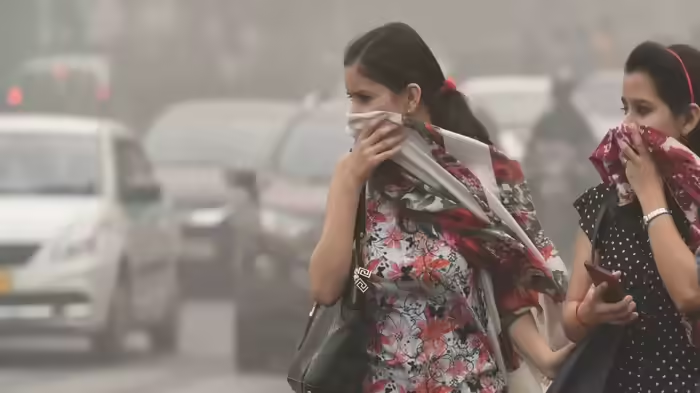
New Delhi, Feb 4: The Union Budget has drawn sharp criticism from environmental experts after allocating less funding for pollution control than last year, raising concerns about the worsening air quality crisis in Delhi-NCR.
Specialists say the budget fails to give adequate priority to air pollution, despite it being one of the region’s most pressing public health emergencies. They argue that no strong, dedicated provision addressing air quality is visible, calling it a major policy lapse.
For 2026–27, the allocation for Pollution Control Boards and the National Clean Air Programme (NCAP) has been fixed at ₹1,091 crore — ₹209 crore lower than the revised estimate of ₹1,300 crore for 2025–26.
Climate activists have reacted strongly to the cut, noting that not only has the allocation decreased, but existing funds have also not been fully utilized in recent years. The reduction comes at a time when pollution-related illnesses and deaths are rising sharply, they said.
Anumita Roychowdhury, Executive Director of the Centre for Science and Environment (CSE), warned that reduced budgetary support could deepen the public health crisis. While NCAP 2.0 is expected to expand in scope, the absence of higher funding and uncertainty over additional grants from the 16th Finance Commission could slow progress. She added that the current budget appears to focus more on industry and the energy sector than on air quality management.
Sunil Dahiya, founder of Envirocatalysts, said the allocation signals that controlling major sources of pollution is not a top government priority. He pointed out that the effective NCAP funding for 82 non-attainment cities is lower than last year’s revised estimates. No new pollution-control programmes have been announced, and there is no dedicated budget push for electric vehicle infrastructure, he noted, adding that expectations are now pinned on the 16th Finance Commission.
Aarti Khosla, Director of Climate Trends, said the budget should have acknowledgingly included clear provisions to reduce pollution in Delhi-NCR, strengthen NCAP 2.0, and accelerate EV infrastructure. The absence of such commitments is deeply concerning, she said.
Discover more from SD NEWS agency
Subscribe to get the latest posts sent to your email.