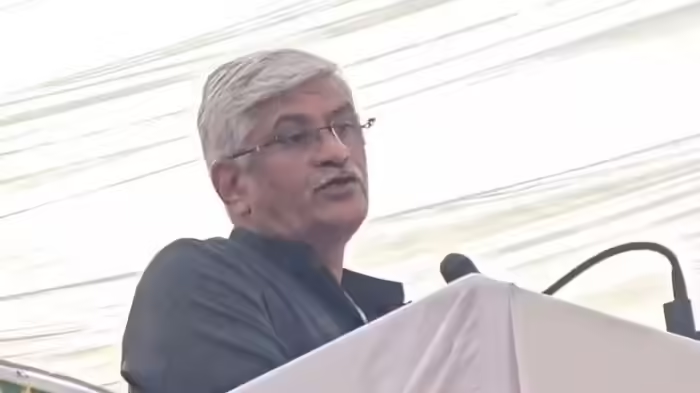
Sri Ganganagar: During a one-day visit to Sri Ganganagar, Union Minister for Tourism and Culture Gajendra Singh Shekhawat sharply criticized the previous Congress government over water-sharing policies. The minister highlighted that under the Indus Water Treaty, former Prime Minister Jawaharlal Nehru had allocated 80% of river waters to Pakistan, ignoring engineers’ warnings, in an attempt to “buy peace”—a move he called detrimental to India’s national interest.
Shekhawat claimed that under Prime Minister Narendra Modi, this policy has been revised. In the coming years, water from the Chenab River will no longer flow to Pakistan but will instead pass through various regions of Rajasthan and reach Gujarat.
Historical Oversight by Nehru
Shekhawat referred to a book written by engineers who were part of the delegation during the 1960–62 treaty negotiations. The engineers had warned Nehru that allocating the Jhelum, Chenab, and Indus rivers to Pakistan while leaving India with only the Ravi, Beas, and Sutlej rivers, and dividing water based on command areas, would pose a significant challenge in the future. Despite the warning, Nehru reportedly sought to “buy lasting peace” by conceding water to Pakistan.
India Received Only 20% of the Water
The minister noted that after 65–66 years, it is clear how much India lost under this agreement. India received only 20% of the water, primarily because the then Maharaja Ganga Singh had constructed the Ganganagar Canal, extending to the Jaisalmer command area. Without this canal, even the Ravi River water would not have come to India.
Modi Government Correcting Past Mistakes
Shekhawat emphasized that the central government is now taking decisive steps to rectify historical oversights and ensure better water management. The plan to divert Chenab River water through Rajasthan to Gujarat reflects this forward-looking strategy, aimed at strengthening India’s water security and self-reliance in the coming decades.
Discover more from SD NEWS agency
Subscribe to get the latest posts sent to your email.