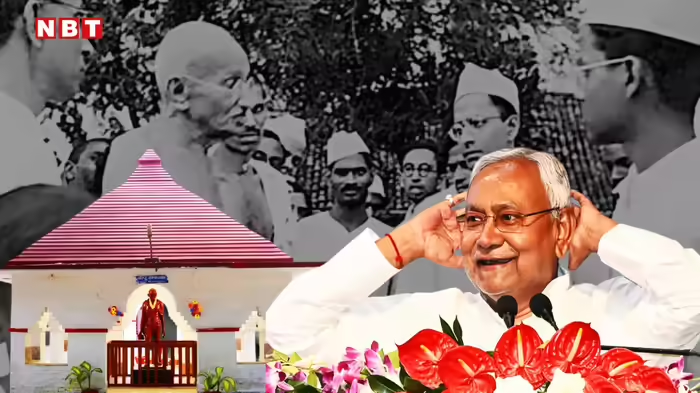
Patna: Gandhian philosophy forms the cornerstone of Nitish Kumar’s politics. His commitment to preserving the memory of Mahatma Gandhi in Champaran is evident through unprecedented efforts, including the restoration of the historic Bhitiharwa Ashram school—a true tribute to the Father of the Nation. By reviving Gandhi’s legacy, Nitish Kumar has effectively introduced the new generation to Gandhi’s ideals and his contribution to Bihar.
Bhitiharwa: A Gandhian Landmark
Champaran holds a special place in the history of Gandhian movements. It was here that Mahatma Gandhi first launched his experiment with the Satyagraha movement. While many leaders have claimed to follow Gandhian principles, few have undertaken the work Nitish Kumar has in preserving Gandhi’s memory in Champaran. During the Champaran movement, Gandhi established an ashram in Bhitiharwa, which also ran a school. On the centenary of the Champaran movement, Nitish Kumar inaugurated a grand renovated school building, paying a heartfelt tribute to Gandhi and acquainting Bihar’s youth with his legacy.
Teachers from Maharashtra and Gujarat
Gandhi came to Champaran to fight for farmers’ rights but also ignited a spark of education and social reform. He established an ashram in Bhitiharwa and opened a school for local children, personally involving himself in education initiatives. Distinguished teachers, including Gandhi and Kasturba Gandhi, led the school. In addition, Sadashiv Laxman Somn from Maharashtra, Balakrishna Yogeshwar Purohit, and Dr. Dev from Gujarat were brought in as teachers, reflecting Gandhi’s commitment to quality education in Bihar. The land for the ashram and school was donated by Baba Ram Narayan Das, further underlining the community’s support.
The School’s Struggle Against Colonial Resistance
On 22 November 1917, Gandhi formally notified the Champaran district administration about the school. The British, fearing that educated children would challenge their authority, opposed the initiative. A local British indigo planter, A.C. Amman, actively resisted the school. Initially started in a small hut, the school building was later burned down by the planter’s goons. Undeterred, Gandhi rallied local support, collecting donations to construct a mud-and-brick school building. Under Kasturba Gandhi’s guidance, women’s education was promoted from the very beginning, with girls being personally taught and encouraged to pursue knowledge.
From Ruins to a Grand Revival
After Gandhi’s departure from Champaran, the school gradually fell into neglect, and by around 2005, it had become a dilapidated structure. Local efforts to sustain it proved insufficient. Following his return as Chief Minister, Nitish Kumar undertook the task of restoring this historic educational site.
In November 2017, to mark the centenary of the school, Nitish Kumar inaugurated a magnificent new building at a cost of ₹22 lakh. Today, the school educates over 435 children, including 243 girls, reflecting the enduring legacy of Kasturba Gandhi’s vision for women’s education. The school now boasts 10 teachers, four separate toilets for boys and girls, and a dedicated kitchen for midday meals, continuing to illuminate the path of knowledge a century after Gandhi first lit this flame.
Discover more from SD NEWS agency
Subscribe to get the latest posts sent to your email.