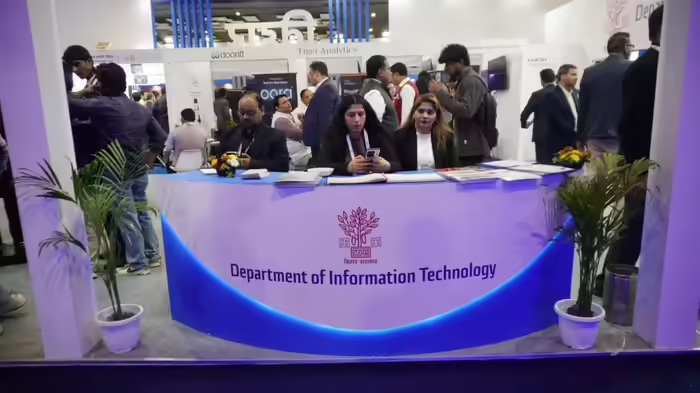
Bihar has once again demonstrated its technological capabilities, this time in the field of Artificial Intelligence (AI), with innovations aimed at improving governance and electoral processes. The state’s initiatives, showcased at the India AI Impact Expo 2026, have captured the attention of policymakers and technology experts from across the country.
At Hall No. 5 of the Expo, the Bihar Pavilion displayed a collaboration between the Bihar State Election Commission, Bihar Institute of Public Administration and Rural Development (BIPARD), Gaya, and the Bihar GenNext Lab, presenting a vision of digital democracy and smart governance. Attending the launch were Rajya Sabha MP Sanjay Kumar Jha, Secretary, Ministry of Steel, Government of India, Sandeep Poundrik, and other senior officials.
India’s First Mobile-Based Remote E-Voting System
MP Sanjay Jha highlighted Bihar’s innovative model: “Bihar has developed a mobile-based e-voting system, AI-assisted vote counting, and data-driven governance via GenNext Lab. This initiative sets the course for a new era of digital democracy in India, strengthening transparency, inclusiveness, and accountability, and positioning Bihar at the forefront of technologically advanced states.”
The Bihar State Election Commission unveiled the country’s first state-level mobile-based remote e-voting system for urban local body elections. Designed for migrant voters, senior citizens, persons with disabilities, and hospitalised voters, the system employs AI, Facial Recognition Systems (FRS), and blockchain technology to ensure vote immutability and enhance the security, transparency, and reliability of elections. Commissioner Dr. Deepak Prasad stated that the initiative could redefine democratic participation and guide future electoral practices.
Curbing Fake Voting
The pavilion also demonstrated an FRS-based voter verification mobile app that prevents fraudulent or duplicate voting through facial recognition. The system matches voters against their existing EPIC (Voter ID) photos with high accuracy and works even in offline mode, significantly strengthening the integrity of elections.
AI-Based OCR Counting for Faster, Accurate Results
To enhance transparency in election results, Bihar introduced an AI-powered OCR counting system, capable of extracting and validating live data from EVM displays. The system creates permanent digital records, video logs, and timestamped audit trails, reducing human error and speeding up results. These technologies have already been successfully deployed in municipal and panchayat elections across the state.
Seven Digital Kiosk Models Transform Governance
Bihar also showcased how AI, data science, and GIS mapping can transform governance through seven digital kiosk models developed at Bihar GenNext Lab. Since its inauguration in October 2024, the lab has trained civil servants in modern administrative techniques and strengthened evidence-based decision-making. The kiosks include:
- Dashboard Kiosk – Real-time data visualization from 45 departments and 38 districts, enabling monitoring and performance comparison at the state, district, and block levels.
- Data Repository Kiosk – Integrates departmental data on a unified digital platform, accelerating policy-making and review processes.
- GIS Mapping Kiosk – Displays locations of government institutions from the panchayat to state level.
- Ask Aryabhat – A chatbot trained on Bihar government datasets, providing officials with analytics, comparisons, and recommendations.
Through these initiatives, Bihar has firmly positioned itself as a pioneer in AI-driven governance, combining technology, data, and innovation to enhance efficiency, transparency, and citizen participation in the democratic process.
Discover more from SD NEWS agency
Subscribe to get the latest posts sent to your email.