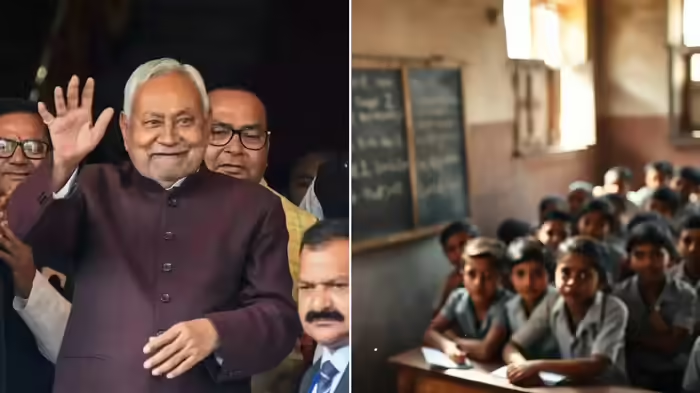
PATNA: Since Nitish Kumar came to power, his government has focused heavily on improving Bihar’s education system. Every year, the state allocates a significant portion of the budget to education, yet quality education remains largely out of reach for students across the state.
Record Budget Allocation for Education
In the 2026-27 Bihar budget, the highest expenditure once again goes to education. The combined budget for primary, secondary, and higher education is ₹68,217 crore, accounting for 19.63% of the total state budget, up from 19.24% in 2025-26. Despite this record spending, questions remain whether the government has succeeded in ensuring quality learning outcomes.
Every Panchayat to Have a High School
In June 2019, Chief Minister Nitish Kumar and the then Deputy CM Sushil Kumar Modi decided that every panchayat in Bihar should have a high school, making Bihar the first state in India to attempt this. The plan included not only high-quality education but also smart classrooms. With over 8,000 panchayats in the state, the initiative aimed to reduce the need for students to travel long distances for secondary education.
Rapid Increase in Schools, But Infrastructure Lags
By August 2020, high school education was introduced in 3,304 panchayats where it did not exist. As of October 2023, Bihar had 9,360 high school and +2 schools, with the government advertising that now “students no longer need to travel far; every panchayat has a 10+2 school.”
However, many schools were upgraded without adequate infrastructure. Middle schools were converted into high schools for numerical targets rather than quality standards. Most of these schools lacked specialist teachers, proper buildings, playgrounds, seating arrangements, and laboratories. Some were even converted into +2 schools despite lacking facilities for higher secondary education.
Smart Classrooms Remain Limited
The government claims improvements in education, but data tells a different story. As of July 2025, out of nearly 78,000 primary, middle, and 10+2 schools, only 7,000 schools (8.8%) had smart classroom facilities. Despite the 2019 goal to equip all high schools and +2 schools with smart classrooms, six years later, most schools still lack interactive boards, projectors, and ICT labs necessary for quality digital learning.
Learning Outcomes Still Low
According to the ACER 2024 report, only 26.3% of Class 3 students can read a simple Class 2 text, and 37.5% can perform basic Class 2 subtraction. While there has been improvement since 2022, these numbers remain alarmingly low. Although government initiatives have increased student enrollment, the quality of education remains inadequate, a concern also highlighted in NITI Aayog reports.
Bihar’s education system, despite high spending and ambitious targets, continues to face challenges in delivering meaningful, quality education to its millions of students.
Discover more from SD NEWS agency
Subscribe to get the latest posts sent to your email.