
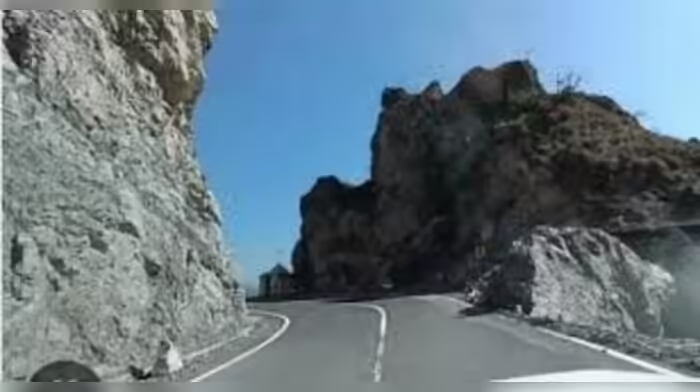
: While Uttarakhand’s ambitious All-Weather Road Project has significantly improved connectivity in the Himalayan region, it is also giving rise to serious geological and safety concerns. A massive crack has developed in the Totaghati hill along the Rishikesh–Badrinath National Highway, triggering alarm among authorities, experts, and local residents.
Located around 40 kilometres from Rishikesh, Totaghati has witnessed the emergence of a 60-centimetre-wide and nearly 26-metre-deep crack in the hill, approximately 100 metres above the highway. The fissure has effectively split the mountain into two parts, raising fears of potential landslides and road blockages on this crucial pilgrimage route.
Hill Cutting Linked to the Damage
The crack is being attributed to extensive hill cutting carried out for widening the highway under the All-Weather Road Project. Large sections of mountains were cut to expand the road, a process that experts say has weakened the natural stability of the slopes in several locations.
The Tehri Hydro Development Corporation (THDC) has been tasked with surveying the crack within a week. After the assessment, a detailed report will be submitted to the Union Ministry of Road Transport and Highways. Authorities aim to complete the evaluation and necessary remedial measures before the upcoming Char Dham Yatra, a period when traffic on the highway increases manifold.
Project Began in 2016
The All-Weather Road Project was launched by the central government in December 2016 with the objective of ensuring year-round connectivity to Uttarakhand’s pilgrimage sites, including Badrinath and Kedarnath. While the widened highways have improved travel, the ecological cost of aggressive mountain cutting is now becoming increasingly visible.
Similar cracks, slope instability, and land subsidence have been reported at multiple locations along the highway, reinforcing concerns that the project may be aggravating environmental risks rather than mitigating them.
Falling Stones, Rising Risk
Since the widening of the road at Totaghati, stones and debris have been frequently falling onto the highway, often disrupting traffic and posing a serious threat to commuters. Several stretches of the road have been classified as danger zones due to the high risk of rockfall and landslides.
On March 1, 2021, the Union Ministry of Road Transport and Highways appointed THDC as the consultancy agency for treating such danger zones. Engineers have already completed the first phase of safety work between Kaudiyala and near Teen Dhara, while the second phase—covering the main Totaghati stretch—is yet to be undertaken.
Monitoring and Repair Before Pilgrimage Season
Officials confirmed that the crack has appeared between two vertical hill faces above the main road. The consultancy agency will conduct a detailed structural study using crack meters to monitor movement and assess the stability of the hill. A comprehensive report will be submitted to the central government within 15 days through the state administration.
Authorities have assured that the crack will be filled and stabilisation work completed before the Char Dham Yatra begins, to prevent any disruption or disaster during the pilgrimage season.
The Totaghati incident has once again highlighted the fragile balance between infrastructure development and environmental stability in the Himalayas—raising critical questions about long-term sustainability and safety in high-altitude road projects.