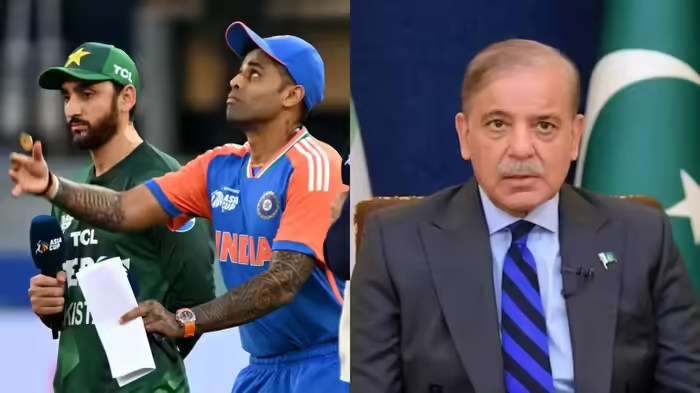
New Delhi: Days before the start of the T20 World Cup 2026, a decision by the Pakistan government has created uncertainty around one of cricket’s biggest rivalries. While Islamabad has cleared the national team to participate in the tournament, it has reportedly instructed the Pakistan Cricket Board (PCB) that the team will not play its scheduled league match against India on February 15.
The move has sparked concern within international cricket circles and raised a key question: what would happen if India and Pakistan both qualify for the final scheduled for March 8?
India’s Possible Road to the Final
India currently sits at the top of the T20 rankings and enters the tournament as one of the favorites. Placed in a group with Namibia, the Netherlands, and the United States, India is widely expected to progress comfortably to the Super 8 stage.
If Pakistan does not take the field on February 15, India would receive two points via walkover under ICC rules. That advantage could strengthen India’s chances of finishing among the top teams in the next round, where tougher opponents such as Australia or England may await. Given India’s recent form, analysts consider the team a strong contender to reach the semifinals and potentially the final.
Pakistan’s Uphill Task
Pakistan’s campaign becomes significantly more difficult if it forfeits the India match. Losing two points without play would put pressure on the team to win its remaining group matches convincingly to stay competitive on net run rate.
To reach the final, Pakistan would likely need to overcome strong sides such as South Africa or New Zealand in the Super 8 and knockout stages. While Pakistan’s bowling attack gives them a fighting chance, the margin for error would be extremely small.
The Final Scenario
The situation becomes more complex if both teams qualify for the championship match.
Under ICC tournament regulations, refusal to play a scheduled match results in a walkover for the opposing side. If Pakistan were to also decline to play the final, India would be awarded the title without a contest. Such an outcome would be unprecedented in a men’s T20 World Cup final and would likely trigger significant debate within the cricketing world.
On the other hand, if Pakistan were to play the final after boycotting the league fixture, critics could question the consistency of the earlier decision. Either scenario places the PCB and the Pakistani government under intense scrutiny.
Financial and Administrative Implications
The controversy could also carry financial consequences. A major portion of PCB revenue comes from ICC distributions, heavily influenced by broadcast value — and India–Pakistan matches are among the most commercially valuable events in global cricket. A forfeited match could expose the board to claims of financial loss from broadcasters.
There is also the broader issue of political interference in cricket administration. The ICC has previously taken action against member boards where government involvement was deemed excessive. Any escalation could risk disciplinary proceedings, adding another layer of uncertainty.
As the tournament approaches, attention now shifts to how cricket’s governing bodies and both nations will navigate a situation that blends sport, politics, and global commercial interests — with the possibility that the world’s most anticipated cricket clash may be decided off the field rather than on it.
Discover more from SD NEWS agency
Subscribe to get the latest posts sent to your email.