Mumbai, Jan 14:
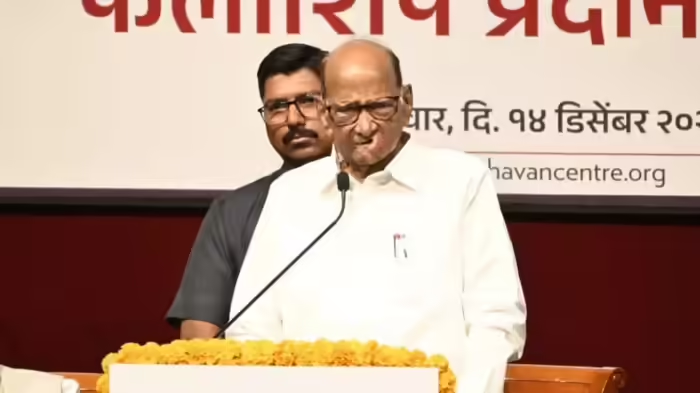
Even before voting begins for Maharashtra’s local body elections, new political equations have started to emerge, sparking intense speculation across the state. Political observers believe that the results of these civic polls could trigger rapid realignments—not only in Maharashtra’s power structure but also in national politics. At the center of this churn is a key question: could veteran leader Sharad Pawar move closer to the NDA after the Brihanmumbai Municipal Corporation (BMC) elections?
The civic polls are scheduled for January 15 across 29 municipal corporations in Maharashtra. These elections are being seen as a litmus test for all major alliances, with shifting loyalties and fractured fronts already visible on both sides of the political divide.
Fragile Opposition, Stable NDA
Ahead of the polls, the I.N.D.I.A. bloc appears deeply divided in Maharashtra. The opposition Maha Vikas Aghadi (MVA)—comprising Congress, Uddhav Thackeray-led Shiv Sena, NCP (Sharad Pawar faction), Samajwadi Party, and others—has virtually splintered. Congress has distanced itself from Uddhav Thackeray over his outreach to Raj Thackeray, while the Samajwadi Party has already exited the alliance. The opposition now appears disorganized and weakened.
In contrast, while the NDA’s constituent parties—the BJP, Eknath Shinde-led Shiv Sena, and Ajit Pawar’s NCP—are contesting against each other in several municipal corporations, there are no visible signs of a broader breakdown in the alliance. Political analysts suggest this competitive contest is tactical rather than ideological.
Why BMC Matters
The BMC holds a unique and decisive place in Maharashtra’s politics. With an annual budget of nearly ₹75,000 crore, it is Asia’s richest civic body. The Thackeray family has controlled the BMC for nearly 25 years, making this election nothing short of an existential battle for them. A defeat here could significantly weaken the Thackerays’ political influence.
This high stake has pushed Uddhav Thackeray to bury past rivalries and join hands with his cousin Raj Thackeray. However, the BJP and the Shinde-led Shiv Sena are positioning themselves as a formidable wall against the Thackeray family’s continued dominance in Mumbai.
Thackeray Unity and Congress Dilemma
While the elections have reduced visible friction within the Thackeray family, political commentators remain skeptical about the durability of this reunion. Adding to the complexity is Congress’s discomfort with Raj Thackeray, who is often perceived as anti-Hindi and anti–North Indian. Any future attempt to formally include Raj Thackeray in the MVA or the broader I.N.D.I.A. bloc could place Congress in a difficult position, especially in Hindi-speaking states.
Pawar vs Pawar—and a Possible Thaw
Perhaps the most significant signal to emerge from the civic election dynamics is the apparent softening of relations between Sharad Pawar and his nephew Ajit Pawar. In Pune and Pimpri-Chinchwad municipal corporations, both NCP factions are reportedly working together to challenge the BJP. This has fueled speculation that the two groups could reunite after the election results.
If such a merger materializes, Sharad Pawar and Supriya Sule’s faction of the NCP would once again become central players in both state and national power equations. This development could open the door to fresh alignments, including the possibility—however tentative—of Sharad Pawar engaging with the NDA in a new political context.
As Maharashtra awaits the civic poll verdicts, one thing is clear: the results are likely to redraw political boundaries, with ripple effects extending far beyond municipal governance and into the heart of Indian national politics.
Discover more from SD NEWS agency
Subscribe to get the latest posts sent to your email.