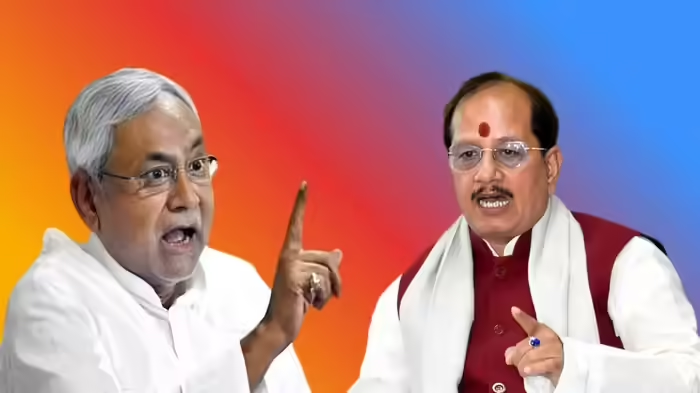
Bihar politics has witnessed several dramatic confrontations over the years, but the face-off between Chief Minister Nitish Kumar and then Assembly Speaker Vijay Kumar Sinha in March 2022 remains one of the most striking examples of a constitutional and political power struggle. What began as a dispute over the transfer of a Deputy Superintendent of Police (DSP) soon escalated into an unprecedented clash on the floor of the House, shaking the state’s ruling alliance and exposing deep fault lines between the executive and the legislature.
At the time, the Home Department was directly under Chief Minister Nitish Kumar. The controversy erupted during the Budget Session of the Bihar Assembly when Speaker Vijay Sinha accused two police officers in Lakhisarai district of misbehaving with him. The allegation quickly snowballed into a major political storm.
Speaker Accuses Police Officers of Insult
The dispute dates back to February 4, 2022, during Saraswati Puja celebrations in Lakhisarai, when a cultural programme allegedly witnessed youths dancing while brandishing firearms — an act claimed by police to be in violation of COVID protocols and the law. Five days later, police arrested two youths and sent them to judicial custody. The arrests triggered allegations of selective and excessive police action, with claims that the accused were innocent and politically targeted.
When Speaker Vijay Sinha visited Lakhisarai — his constituency — he summoned DSP Ranjan Kumar and the local Station House Officer for clarification. Sinha reportedly questioned the basis of the arrests and demanded withdrawal of the cases, alleging there was no proof of weapons being displayed. Soon after, the Speaker accused the DSP of insulting and disrespecting him.
Assembly Turns Into a Battlefield
The issue reached the Assembly, where Parliamentary Affairs Minister Bijendra Prasad Yadav assured appropriate action. However, no immediate disciplinary step followed. This angered BJP legislators, who repeatedly raised the issue in the House, cornering their own government. The opposition RJD seized the opportunity, accusing the Chief Minister of undermining the authority of the Speaker and damaging the dignity of the legislature.
Repeated disruptions over the same issue visibly irritated Nitish Kumar, who argued that matters under police investigation should not be debated in the House.
Nitish Kumar Loses Temper in the House
On March 15, 2022, the confrontation reached its peak. Watching the chaotic proceedings from his chamber, Nitish Kumar suddenly entered the House, visibly furious. In a sharp and unprecedented outburst, he questioned the Speaker’s conduct, asking whether the House had the authority to seek police investigation reports and asserting that such powers rested with the judiciary.
“Is this the way to run the House? Read the Constitution,” Nitish Kumar remarked sternly, leaving members stunned. His comments were widely seen as a direct challenge to the authority of the Speaker, further escalating the crisis.
Political Embarrassment Forces Compromise
As the standoff intensified, it began to embarrass the ruling NDA government. Damage control efforts followed. A closed-door meeting was held at the Assembly annexe involving Nitish Kumar, Vijay Sinha, and senior leaders, with media kept out. The tone softened thereafter.
Finally, on March 18, 2022, the Chief Minister ordered the transfer of DSP Ranjan Kumar from Lakhisarai, appointing Syed Imran Masood in his place. This was precisely the outcome Speaker Vijay Sinha had been demanding from the beginning.
Political Undercurrents Behind the Clash
The controversy also carried strong political undertones. RJD leaders alleged that the officers were being shielded due to their proximity to JD(U) president and MP Lalan Singh. Interestingly, both Lalan Singh and Vijay Sinha belong to the same Bhumihar Brahmin community and share political turf in and around Lakhisarai and Munger, where rivalry for local dominance has long simmered.
Who Won the Battle?
While Nitish Kumar stood firm initially on constitutional grounds, the eventual transfer of the DSP made it clear that political pragmatism prevailed over principle. In the end, it was the Speaker’s demand that was met — signalling that even a powerful Chief Minister sometimes has to concede to preserve political stability and institutional balance.
The episode remains a textbook case of how administrative decisions, political rivalries, and constitutional authority can collide — with lasting lessons for Bihar’s governance and power dynamics.
Discover more from SD NEWS agency
Subscribe to get the latest posts sent to your email.