Authored By: Ashok Kumar Sharma • Reported By: Sudhendra Pratap Singh | NavbharatTimes.com • 8 Dec 2025, 10:01 AM IST
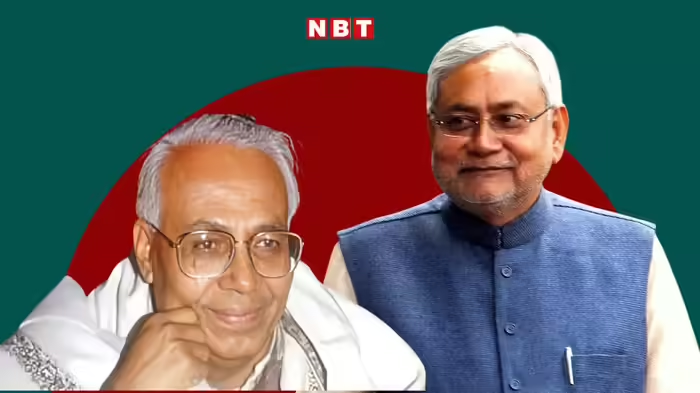
Patna: The Chief Minister’s residence at 1 Aney Marg has witnessed the rise of several political eras in Bihar. The first chief minister to live here was Bhagwat Jha Azad, known for his strict, disciplined governance. Today, the same address is occupied by Chief Minister Nitish Kumar, who, as a young opposition MLA, had once closely observed Azad’s style of administration.
At the time, Nitish Kumar and Lalu Prasad Yadav were both members of the Bihar Assembly. As Lok Dal opposition legislators, they witnessed Azad’s uncompromising approach to law and order from a front-row seat. Azad’s “Janata Darbar” was widely discussed for its transparency and direct public engagement. Years later, Nitish Kumar revived the concept in his own way, renaming it “Janata Ke Darbar Mein Mukhyamantri”, emphasising that the Chief Minister is a servant of the public and must present himself before them.
Nitish Kumar Appointed Azad’s Son as MLC
Although Nitish Kumar rarely speaks about how deeply he was influenced by former CM Azad, one decision hints at mutual respect. After Upendra Kushwaha resigned from the Bihar Legislative Council in 2023, Nitish nominated Dr. Rajvardhan Azad, the elder son of former CM Bhagwat Jha Azad, to the vacant MLC seat.
Dr. Rajvardhan Azad — a renowned ophthalmologist — was inducted as a nominated member of the Legislative Council.
Politically Divided Brothers, Yet Nitish Favoured Rajvardhan
Dr. Rajvardhan’s younger brother, Kirti Azad, was once a BJP MP but is now with the Trinamool Congress. In 2013, Kirti Azad had a major confrontation with Nitish Kumar, escalating tensions between BJP and JDU. Despite this, Nitish Kumar continued to support Rajvardhan Azad.
In fact, in 2014, he fielded Rajvardhan Azad as a Lok Sabha candidate.
Contested Lok Sabha Polls from Godda
At that time, Dr. Rajvardhan was serving at the prestigious AIIMS-Delhi. He resigned from his job to contest the election — a decision that angered his family, especially Kirti Azad, who questioned why his brother was running on a JDU ticket.
Since former CM Bhagwat Jha Azad hailed from Kaswa village in Godda (now in Jharkhand), Rajvardhan requested the JDU ticket from Godda. However, the election ended in a major defeat, with Rajvardhan finishing in seventh place, while BJP’s Nishikant Dubey won.
The Return of ‘Good Governance’: Revisiting Azad’s Chief Ministerial Style
Bhagwat Jha Azad served as Chief Minister from 14 February 1988 to 10 March 1989. After years of instability, his tenure brought a refreshing sense of rule of law. While controversies existed, his early months in office were widely appreciated.
By April–May 1988, a noticeable shift could be felt in governance. His most impactful step was reviving trust in the government through his strict, transparent Janata Darbar.
Inside CM Azad’s Janata Darbar: May 1988
It is 10:30 AM at the CM residence. The gate opens. Dozens of citizens holding application letters stand in queue.
No checking. No questioning. No bureaucracy.
A tent is set up in the courtyard with chairs for complainants. Officers and stenographers take their seats. CM Bhagwat Jha Azad arrives, and the Janata Darbar begins.
Case 1: Land Grab Complaint
An elderly man from Vaishali approaches. As he begins narrating his story in detail, Azad interrupts:
“State the problem directly.”
The man explains that local strongmen have encroached upon his land.
Azad immediately dictates a written order to the District Magistrate.
“Your problem will be resolved,” an officer tells the old man.
Case 2: A Woman Tries to Touch His Feet
A woman attempts to touch the CM’s feet for blessings. Azad sternly objects:
“Who told you to touch my feet? Tell me your issue.”
He listens and directs officers to take action.
Case 3: Political Complaint Angers CM
Some Youth Congress workers from Jharkhand raise political grievances.
Azad scolds them:
“Have you ever looked within yourselves to see why these problems arise? Work for the poor.”
They leave silently.
Case 4: A Government Officer Arrives Without Permission
A Deputy Director approaches.
“I am a government servant,” he says.
Azad interrupts sharply:
“You are a government servant, and you came to the CM without taking leave from your superior?”
When the officer says no, Azad orders:
“Suspend him immediately.”
As the officer pleads for mercy, Azad revises the order:
“Make it one year’s suspension.”
The officer collapses into apologies. Finally, Azad relents and cancels the suspension, saying:
“If you break discipline, the entire Secretariat will follow you here. There is a rule for everything.”
The Foundation of Governance
These moments from Azad’s Janata Darbar helped lay the groundwork for a disciplined administrative culture. Years later, Nitish Kumar would replicate and refine the same model at 1 Aney Marg — the very address once occupied by the man whose governance he had watched closely as a young MLA.