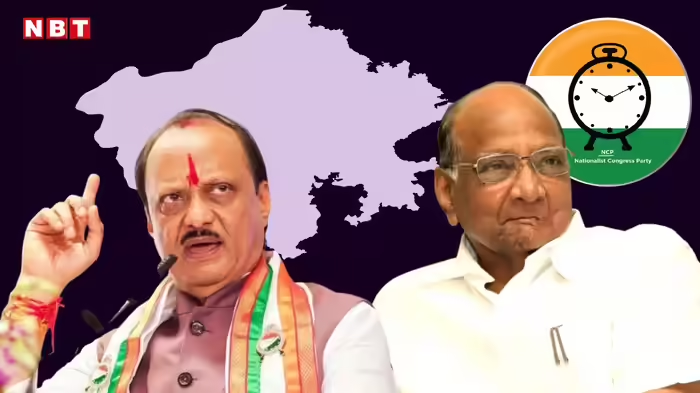
Jaipur, Rajasthan: Sharad Pawar’s attempts to establish the Nationalist Congress Party (NCP) in Rajasthan failed despite multiple efforts. The party was often perceived as an ally of Congress, and voters did not embrace it as an independent political force. Political analysts attribute this failure to three critical missteps by NCP leadership.
Ajit Pawar’s Unfulfilled Ambition
Ajit Pawar, who tragically passed away in a plane crash on January 28, 2026, had officially taken the reins of the NCP in 2024. Under his leadership, the party aimed to regain its national status, which it had lost after internal splits in 2003. Ajit Pawar’s campaign included contesting elections beyond Maharashtra, such as in Bihar, but these attempts did not succeed due to weak preparation and strategic miscalculations.
Lessons from Regional Politics
Analysts note that other regional parties like Mayawati’s Bahujan Samaj Party (BSP) have successfully expanded beyond their home states. BSP, starting in Uttar Pradesh, has gradually established a presence in Rajasthan, Bihar, Punjab, and even internationally in the UK. Its success lies in cultivating a dedicated core vote base and strong grassroots organization.
Why NCP Couldn’t Make Inroads in Rajasthan
Political expert Ashok Sharma explains that NCP’s struggle in Rajasthan can be traced to three main reasons:
- Lack of Core Voter Connect:
Unlike BSP, which built its politics around Dalit and Bahujan communities, NCP failed to identify a clear voter base in Rajasthan. Without a distinct appeal to farmers, SC/ST communities, OBCs, or minorities, the party left voters unsure of whom it truly represented. - Weak Grassroots Organization:
BSP, even without forming government, established a strong booth-level presence with dedicated cadres and local leaders. NCP’s activities in Rajasthan, however, were mostly election-season driven—visible for a few months before vanishing after polls. Analysts note that in a large, complex state like Rajasthan, a permanent organizational network is crucial for sustained political impact. - Overshadowed by Congress:
Outside Maharashtra, NCP has often been seen as Congress’s B-Team. In Rajasthan, where Congress already has a robust organization, NCP failed to present itself as a credible alternative. Voters largely questioned the need for NCP when Congress was already established. In contrast, BSP consistently positioned itself as a distinct third option, separate from both Congress and BJP.
Conclusion
Despite Ajit Pawar’s vision and efforts, NCP’s inability to define its voter base, build a lasting organizational structure, and distinguish itself from Congress meant the party could not secure a foothold in Rajasthan. The lessons from Rajasthan underscore the importance of clarity, organization, and independent identity in regional politics.
Discover more from SD NEWS agency
Subscribe to get the latest posts sent to your email.