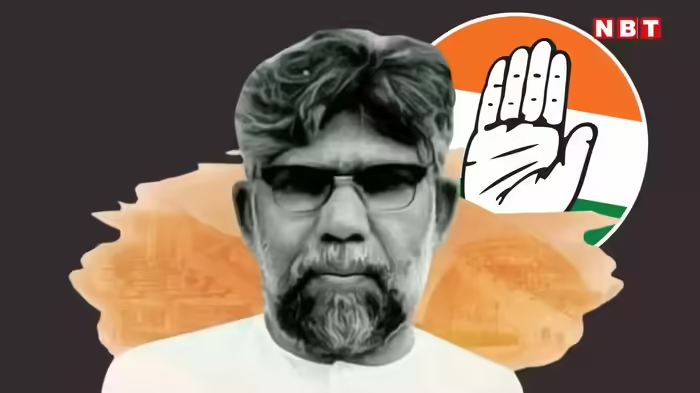
Patna, January 9, 2026: On this day in 1972, the government of Bhola Paswan Shastri, a towering leader in Bihar, fell due to the intrigues and internal machinations of the Congress party. Shastri, who served as Bihar Chief Minister three times, was first chosen as an independent legislator—a rare occurrence in the state’s political history. His final day as acting CM was January 9, 1972, following betrayal and political pressures orchestrated by Congress.
Independent Leader Amidst Political Turbulence
Shastri became Chief Minister for the third time on June 2, 1971, as an independent legislator with minimal numbers. At the time, Congress treated him as a puppet CM, and internal conflicts forced him to resign on December 27, 1971. However, he continued as acting CM until January 9, 1972, when no alternative government could be formed, and the Assembly was dissolved, leading to President’s Rule.
Bihar’s Truncated Governments in the Late 1960s
Bihar witnessed political instability following the 1969 mid-term elections, where no party achieved a majority. Congress emerged as the largest party with 118 out of 324 seats, but coalition governments became inevitable. Shastri’s second tenure as CM lasted only 13 days, after which President’s Rule continued for 225 days. Subsequent governments led by Daroga Prasad Rai and Karpoori Thakur also had brief tenures, reflecting a period marked by political opportunism and fragile alliances.
Congress Split and Shastri’s Marginalisation
The 1969 Congress split further complicated Bihar politics. Indira Gandhi’s faction, Congress (R), secured decisive victories in the 1971 Lok Sabha elections, prompting legislators to flock to her camp. Bhola Paswan Shastri, who had initially won from the Kodha (now Katihar) constituency on a Democratic Congress ticket, found himself isolated after his party colleagues abandoned him, leaving him to act as an independent legislator.
Congress’s Political Manoeuvring
With 118 legislators, Congress chose Shastri as CM for their political advantage, while other small parties and independents supported him externally. Even CPI extended its support initially. However, Congress’s internal pressure tactics, coupled with threats regarding the implementation of promises made during the 1971 Lok Sabha elections, undermined Shastri’s authority.
One major flashpoint was the Justice Datta Commission, formed by Karpoori Thakur’s government in May 1971 to investigate a financial scam linked to the Bharat Sevak Society. Congress leaders, particularly from Lalit Narayan Mishra’s faction, pressured Shastri to disband the Commission. Despite CPI’s opposition, Shastri ultimately bowed to Congress’s pressure, dissolving the Commission and losing CPI’s support.
Factionalism Within Congress
Congress at the time was fragmented into three major factions: Lalit Narayan Mishra, Ramlakhan Singh Yadav, and Daroga Prasad Rai. Each faction consistently exerted pressure on Shastri to satisfy its demands, leaving him politically cornered. Facing relentless coercion, Shastri resigned on December 27, 1971, marking the end of his tenure.
Bhola Paswan Shastri’s government remains a landmark in Bihar’s political history, exemplifying the fragility of coalition politics and the manipulative power of party machinations during a period of extreme instability.
Discover more from SD NEWS agency
Subscribe to get the latest posts sent to your email.