Patna:
The political journey of the Nationalist Congress Party (NCP) in Bihar has largely remained on the margins. In its more than 25-year-long existence, the party tasted real success in the state only once — in 2005. Thereafter, NCP failed to make any significant electoral impact in Bihar. Political analysts believe that had a key strategic gamble taken by NCP chief Ajit Pawar succeeded, the party might have emerged as a national force comparable to the BJP and Congress.
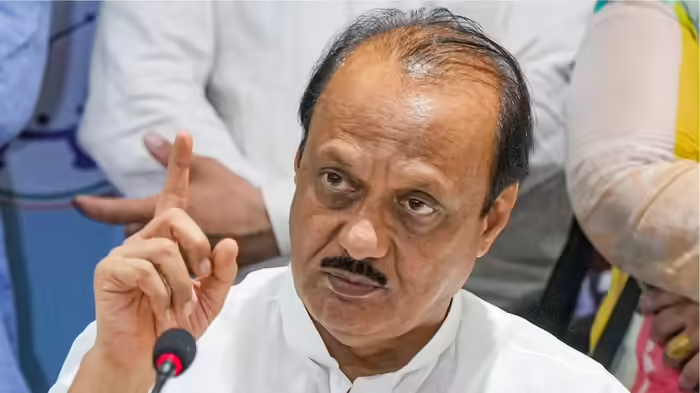
Ajit Pawar, who took over the reins of the NCP after receiving recognition from the Election Commission in 2024, had envisioned transforming the party into a national player. Bihar was central to this plan. However, the strategy ultimately failed, marking a major setback in Pawar’s political ambitions.
Early Promise, Gradual Decline
Formed in 1999 after a split from the Congress, the NCP initially built a modest base in Bihar, particularly in the Seemanchal region, including districts such as Katihar and Purnea. Senior leader and former Union Minister Tariq Anwar remained the face of the party in the state for years.
According to senior journalist Ashok Sharma, the exit of Tariq Anwar in 2018 proved to be a decisive blow. After he rejoined the Congress, the NCP’s organisational structure in Bihar almost collapsed. The party neither managed to rebuild its cadre nor forge a strong regional alliance. Currently, Tariq Anwar is a Congress MP from Katihar.
2025 Assembly Elections: A Strategic Misstep
After assuming party leadership in 2024, Ajit Pawar decided to contest the 2025 Bihar Assembly elections independently. The NCP fielded candidates on 15 seats, but the results were disastrous. In several constituencies, NCP candidates polled fewer votes than NOTA. Thirteen candidates lost their security deposits, and the party secured a mere 0.02 per cent vote share statewide.
The poor performance shattered Pawar’s hopes of securing national party status for the NCP and reportedly deepened his frustration.
‘We Were Not Prepared for Bihar’: Ajit Pawar
Following the zero-seat outcome, Ajit Pawar’s reaction surprised many within political circles. He openly stated that he was not in favour of contesting the Bihar elections and claimed that he was not even adequately informed about the decision.
Political observers believe Pawar was aware that entering a complex state like Bihar without strong local leadership and grassroots support would amount to political self-destruction — a prediction that ultimately came true.
NCP’s Electoral Record in Bihar
- Assembly Election 2025: Contested independently; won 0 seats
- Assembly Election 2020: Fielded candidates on select seats; no victories
- Assembly Election 2015: Contested as part of a ‘Third Front’ with the Samajwadi Party; won 0 seats
- Assembly Election 2010: Failed to secure any seat
- Assembly Election October 2005: Won 1 seat (Abdul Jalil from Kadwa)
- Assembly Election February 2005: Best performance; won 3 seats — Subodh Kumar (Shikarpur), Mohammad Shakoor (Barari), and Abdul Jalil (Kadwa)
An Unfulfilled National Dream
Ajit Pawar’s Bihar experiment was seen as a bold but risky move aimed at expanding the NCP beyond its traditional strongholds. Had it succeeded, it could have altered the national political landscape. Instead, the failure exposed the limitations of electoral expansion without a solid organisational base, bringing Pawar’s national aspirations to an abrupt halt.
Discover more from SD NEWS agency
Subscribe to get the latest posts sent to your email.