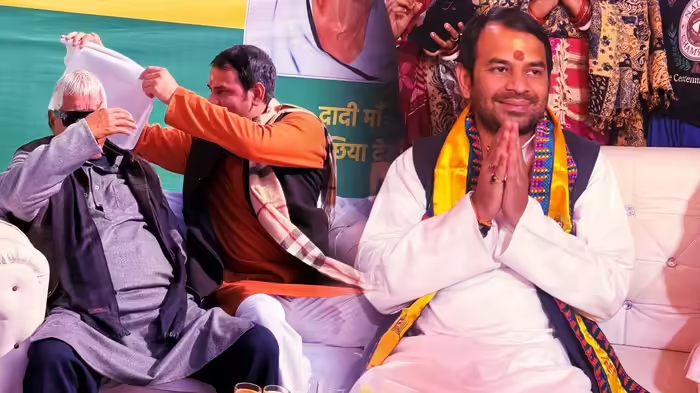
Patna: In Bihar’s politics, electoral success is rarely determined by performance alone. Social and caste equations continue to play a decisive role, often outweighing development work and administrative achievements. Former health minister and RJD leader Tej Pratap Yadav’s political journey is a striking example of this reality.
Lalu Prasad Yadav’s elder son, Tej Pratap Yadav, faced a major setback when he was expelled from the Rashtriya Janata Dal (RJD) for six years. He later floated a separate political platform and contested elections independently. However, the experiment failed to yield any significant political gains. His crushing defeat in the 2025 Mahua Assembly election exposed his growing political isolation and inability to consolidate a winning social coalition.
Why Did Tej Pratap Yadav Lose?
In the 2015 Assembly elections, Tej Pratap Yadav contested as an RJD candidate and benefited from the party’s strong MY (Muslim-Yadav) social equation, which paved the way for his victory. By 2025, however, his relationship with his father and the party leadership had deteriorated. As a result, the traditional MY support base did not rally behind him.
The situation became more complex as two candidates from the Yadav community were in the fray, splitting votes. Taking advantage of this division, Lok Janshakti Party (Ram Vilas) candidate Sanjay Singh emerged victorious. Notably, Sanjay Singh secured more votes than the combined tally of RJD candidate Mukesh Roshan and Tej Pratap Yadav, highlighting the depth of Tej Pratap’s political setback.
Abandoning Mahua Proved Costly
Political observers believe that Tej Pratap Yadav’s decision to leave Mahua midstream in the 2020 Assembly elections and contest from Hasanpur severely damaged his credibility. Although Mahua received a medical college and other developmental initiatives during his tenure, voters felt betrayed when he chose another constituency.
This perception took firm root among the electorate—that Tej Pratap Yadav lacked long-term commitment to a constituency. The belief that he could abandon a seat even after winning made voters skeptical about his promises. Consequently, during the 2025 election, even his pledge to establish an engineering college alongside the medical college failed to restore public trust.
Caste Dynamics Trump Development
Senior journalist Om Prakash Ashk has pointed out that electoral victories in Bihar are not solely driven by development work. Immediate benefits and social calculations often determine voter behavior. He cites examples where welfare announcements and financial incentives influenced public trust more than long-term governance records.
Another senior journalist, Arun Pandey, echoes this view, stating that in Bihar, votes are rarely cast purely on the basis of performance. A strong caste-based social coalition is essential for electoral success. According to him, Tej Pratap Yadav failed to craft such a coalition. After breaking away from RJD, he could not emerge as a unifying Yadav leader, nor could he build a broader social alliance.
Political Lesson
Tej Pratap Yadav’s defeat underscores a harsh truth of Bihar’s political landscape: development alone is not enough. Without a strong social and caste-based support structure, even influential political legacies and visible work on the ground may fall short at the ballot box.
Discover more from SD NEWS agency
Subscribe to get the latest posts sent to your email.