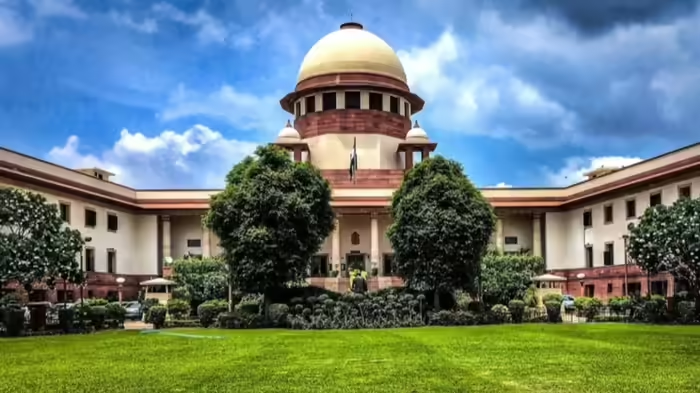
The Supreme Court on Thursday directed the Election Commission of India to publicly display the names of voters listed under the Special Intensive Revision (SIR) process with logical discrepancies. The names are to be posted at Gram Panchayat offices, block offices, and other public locations to allow citizens to review the records and submit any objections or supporting documents.
Hearing and Background
The bench, led by Chief Justice S. R. Suryakant, heard arguments from senior advocates Kapil Sibal, Amit Anand Tiwari, and Vivek Singh on behalf of the Dravida Munnetra Kazhagam (DMK). The DMK had requested that voters whose names appear in the discrepancy list in Tamil Nadu be given adequate time to claim inclusion in the pre-election voter list.
The Supreme Court’s directions aim to ensure that individuals listed in the SIR process have a fair opportunity to address discrepancies and protect their right to vote.
Challenge to SIR Process
Separately, the Supreme Court has reserved its decision on a batch of petitions challenging the SIR process in Bihar, including a petition filed by the NGO Association for Democratic Reforms. The petitions question whether the Election Commission has the constitutional authority under Article 326, the Representation of the People Act, 1950, and associated rules, to conduct SIR in its current form.
NRC Comparison and Election Commission’s Position
Petitioners argued that SIR is effectively an “NRC-like process”, turning the Election Commission into a body that verifies citizenship, which should follow procedures outlined under Section 16 of the Representation of the People Act whenever a voter’s eligibility is questioned. The Election Commission clarified that citizenship verification is limited to electoral purposes and is not intended to exclude non-citizens from the country. It emphasized that the process is liberal and soft-touch, without any rigorous or punitive investigation.
Discover more from SD NEWS agency
Subscribe to get the latest posts sent to your email.