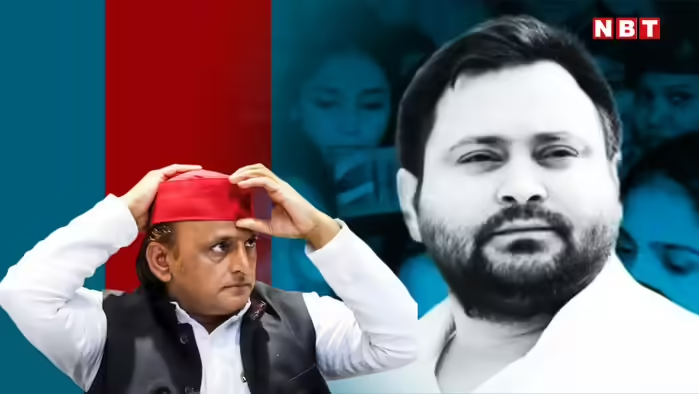
In Indian politics, inheriting a party legacy does not automatically translate into the ability to run it effectively. Managing a political party—especially one built around personality worship—is no “easy meal.” On the contrary, legacy often becomes a heavy burden, as the successor is constantly compared with the founder. This comparison alone can turn into the biggest reason for failure.
The experience of Samajwadi Party president Akhilesh Yadav makes this reality evident. Despite his education abroad and early entry into politics, Akhilesh could not run the party with the authority and effectiveness expected of Mulayam Singh Yadav’s political heir. The weakening of the Samajwadi Party in Uttar Pradesh paved the way for the BJP to return to power twice in succession. Against this backdrop, the growing discussion around handing over the reins of the Rashtriya Janata Dal (RJD) to Tejashwi Yadav raises a critical question: is merely inheriting a legacy enough to sustain a party built on charisma?
At 36, Tejashwi Yadav is being projected as the future of RJD, largely because he is Lalu Prasad Yadav’s son. But when placed against Lalu Yadav’s political skill, experience, and mass appeal, Tejashwi’s challenges appear formidable.
Lalu Yadav: Standing Tall Against the Odds
Lalu Prasad Yadav remains a rare figure in Indian politics—someone with an unmatched ability to swim against the tide. A master of political manoeuvring and coalition management, he rose rapidly by outsmarting seasoned leaders. In 1988, he emerged as Leader of the Opposition, and by 1990, he became Chief Minister of Bihar through sheer political acumen.
Even while heading a minority government supported by ideologically diverse allies—the BJP, Left parties, Jharkhand Mukti Morcha, and independents—Lalu Yadav never appeared weak or compromised. He ruled with confidence, keeping allies firmly under control through political skill rather than organizational strength. Remarkably, he completed five full terms as Chief Minister, a feat even stalwarts like Karpoori Thakur could not achieve.
Tejashwi’s Limited Grip Over Allies
During the 2025 Bihar Assembly elections, Tejashwi Yadav informally took many key decisions for the RJD. However, his lack of experience proved costly. Political analysts pointed out that he failed to accurately assess the real strength and ambitions of alliance partners within the Mahagathbandhan.
Over-reliance on caste arithmetic without adequate ground-level assessment weakened the party’s electoral strategy. Leaders like Mukesh Sahni—who had never tasted major electoral success earlier—began to dominate negotiations. The Congress also kept Tejashwi on the defensive over the chief ministerial face issue. Unlike Lalu Yadav, Tejashwi could not assert decisive control over coalition partners and often appeared hesitant.
Weak Leadership, Weak Organization
History shows that when a party’s organization and leadership weaken, the party gradually loses its relevance. Bihar’s CPI once had 35 MLAs in 1972, backed by a strong cadre-based structure. Yet, in the absence of capable leadership, the party declined and today survives on one or two seats at best. Several caste-based parties and regional outfits met a similar fate.
Parties that depend solely on caste equations rather than organizational strength rarely enjoy a long political life.
RJD: Built on Charisma, Not Cadres
Under Lalu Yadav, RJD’s organization existed more on paper than in reality. Long lists of office-bearers meant little, as all power and decision-making were concentrated in Lalu himself. The party functioned like a one-man army, driven by his personal charisma rather than institutional strength. As long as electoral victories continued, this weakness remained hidden.
Tejashwi Yadav has now lost two consecutive Assembly elections. With the party’s tally shrinking sharply, the importance of grassroots organization is being felt for the first time. Caste support and party organization are not the same. RJD, critics argue, has consistently undervalued its ordinary workers.
Former Prime Minister Atal Bihari Vajpayee once observed that parties are run not by leaders alone, but by workers. That lesson, applicable to all political outfits, now confronts RJD head-on.
The question, therefore, is not just whether Tejashwi Yadav can inherit his father’s position, but whether he can rebuild a party that was never designed to function without Lalu Yadav’s towering presence.
Discover more from SD NEWS agency
Subscribe to get the latest posts sent to your email.