New Delhi: In a rare display of political unanimity, the Union Cabinet has approved a proposal to officially rename the state of Kerala as “Keralam,” following a unanimous resolution passed earlier by the Kerala Legislative Assembly. The move has brought questions of cultural identity and linguistic authenticity to the forefront of state politics, especially in a year when Kerala is heading toward Assembly elections.
The proposal received support across party lines — from the ruling Left Democratic Front (LDF) to the BJP and the Congress-led United Democratic Front (UDF) — making it an unusual moment of consensus in an otherwise fiercely competitive political landscape.
Restoring Linguistic Authenticity
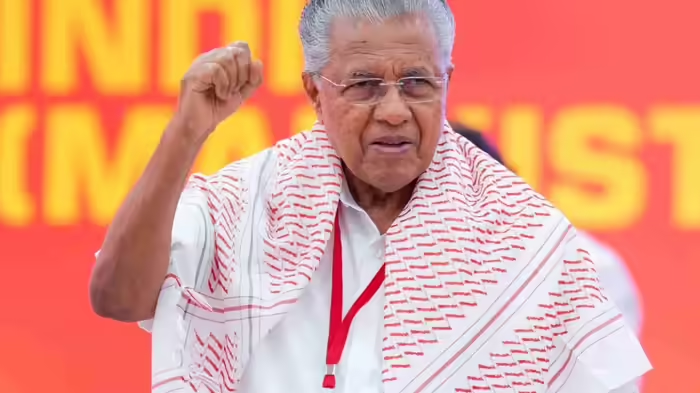
Chief Minister Pinarayi Vijayan has argued that “Keralam” is the state’s original and culturally authentic name in Malayalam, while “Kerala” is the anglicized version popularized during the colonial period.
In a recent communication to state BJP president Rajeev Chandrasekhar, Vijayan noted that the name “Keralam” reflects the region’s historical and linguistic roots and that the change seeks to correct a colonial-era adaptation.
The Kerala Assembly first passed the resolution in 2023 and reaffirmed it in June 2024 after technical revisions. With the Centre’s approval now in place, the formal process of renaming the state at the constitutional level is expected to proceed.
Identity Politics in an Election Year
With Assembly elections scheduled later this year, the renaming has taken on political significance beyond administrative formalities. For the LDF, the emphasis on linguistic pride and federal rights aligns with its longstanding political narrative. Analysts suggest that issues of language and identity often carry emotional and symbolic weight in Kerala’s electorate.
The BJP’s support for the move is seen as an effort to expand its political footprint in the state by endorsing a culturally resonant demand. Meanwhile, the Congress-led UDF chose not to oppose the resolution, avoiding the political risk of appearing indifferent to regional sentiment.
The consensus signals that no major party wanted to be perceived as standing against Kerala’s cultural self-assertion.
Historical Roots of ‘Keralam’
The name “Keralam” has deep historical foundations. References to the region date back over 2,200 years, including mentions in the rock edicts of Ashoka, where the Chera rulers were noted. Linguists believe the term historically referred to the lush western coastal belt stretching from present-day Karnataka to Kanyakumari in Tamil Nadu.
Modern Kerala emerged on linguistic lines. In 1949, the princely states of Travancore and Cochin merged to form Travancore-Cochin. Later, following the recommendations of the States Reorganisation Commission, the Malabar region and Kasaragod were integrated, and the state of Kerala formally came into existence on November 1, 1956.
Symbolism Beyond Semantics
While the name change may appear largely symbolic, it reflects a broader assertion of regional identity and linguistic pride. In a state known for its strong political consciousness, the shift from “Kerala” to “Keralam” is being viewed not merely as a change in spelling, but as a reaffirmation of cultural heritage.
As election season approaches, the convergence of political forces on this issue underscores how identity politics — when rooted in shared cultural sentiment — can transcend partisan divides.
Discover more from SD NEWS agency
Subscribe to get the latest posts sent to your email.