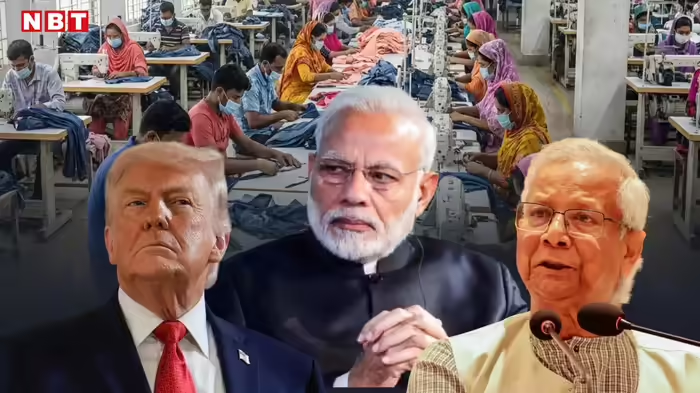
Dhaka/Washington: Following India’s landmark trade agreement with the European Union, India has now signed a trade deal with the United States, confirmed by Prime Minister Narendra Modi and U.S. President Donald Trump. The agreement reduces the U.S. tariff on Indian goods from 50 percent to 18 percent, marking a major win for India and a potential setback for neighboring countries like Bangladesh and Pakistan.
The deal comes as a double blow to these regional economies, which were already grappling with the India-EU trade agreement. Currently, the U.S. imposes tariffs of 20 percent on Bangladeshi products and 19 percent on Pakistani goods, making Indian exports more competitive under the new arrangement.
Mohammad Yunus’ Earlier Remarks
You may recall how Mohammad Yunus, advisor to Bangladesh’s interim government, had previously mocked India over tariffs. In an interview with British-American journalist Mehdi Hasan, Yunus praised Bangladesh’s own trade deal with the U.S., saying:
“We are happy with the 20 percent tariff on our goods—it’s reasonable and not a concern.”
He had also jabbed at India, noting:
“Oh, India faces very high tariffs. Often I say Indian industries will set up shop in Bangladesh because the impact here is much less.”
Impact on Bangladesh’s Textile Industry
The India-US deal now intensifies pressure on Bangladesh’s textile industry. Under the new tariff structure, Indian products are cheaper in the U.S. than Bangladeshi goods, giving India a clear competitive edge. Bangladesh exports heavily to both the European Union and the U.S., and analysts warn that post-2029, its exports to Europe could decline by as much as 50 percent due to India’s enhanced manufacturing and supply capabilities.
Bangladesh’s exporters, who had previously benefited from the EU’s EBA (Everything But Arms) duty-free scheme, now face stiffer competition from India, whose products will enjoy lower tariffs and broader market access. This could force Bangladeshi exporters to reassess pricing, quality, and supply chain strategies.
What This Means Going Forward
Although the U.S. tariff on Indian goods remains at 18 percent, lower than the 20 percent on Bangladeshi products, the competitive advantage in price and supply will likely favor India. The new trade deal is expected to intensify rivalry in the U.S. market, where Indian exporters may capitalize on lower tariffs, robust supply chains, and improved market access.
Bangladesh, facing this new reality, may need urgent policy and strategic interventions to maintain its share in global textile exports.
Discover more from SD NEWS agency
Subscribe to get the latest posts sent to your email.