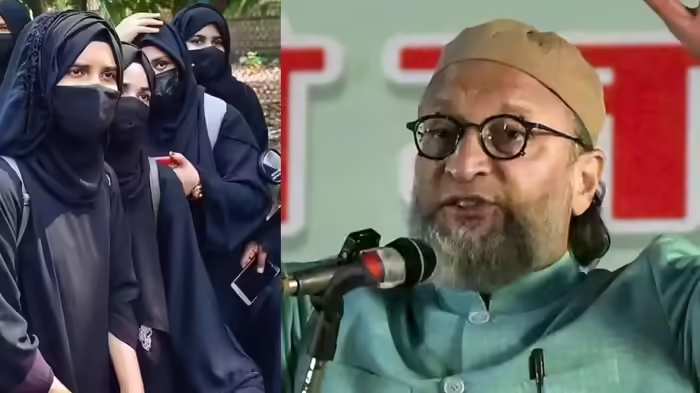
A political and social debate has erupted across the country after AIMIM chief Asaduddin Owaisi remarked that “one day, a woman wearing hijab will become the Prime Minister of India.” The statement has drawn sharp reactions from the Bharatiya Janata Party (BJP), with its leaders questioning both the intent and implications of Owaisi’s comment.
Responding strongly, BJP Rajya Sabha MP Sudhanshu Trivedi challenged Owaisi by citing examples from across the Muslim world. “Several Muslim women have served as Prime Ministers in different countries. How many of them did you ever see wearing a burqa?” Trivedi asked.
He pointed out that Begum Khaleda Zia and Sheikh Hasina in Bangladesh, Benazir Bhutto in Pakistan, and Megawati Sukarnoputri in Indonesia—home to the world’s largest Muslim population—have all served as heads of government. “Did any of them govern their countries wearing a burqa?” he questioned, arguing that leadership and governance have never been dependent on religious attire.
‘Politics Over Reform’ Allegation
Trivedi further alleged that Owaisi was attempting to politicise the issue of Muslim women rather than focusing on genuine empowerment. He referred to families claiming direct lineage from Prophet Muhammad, including Shah Hussein of Jordan’s royal family, and asked how many women from those families wear the burqa.
“This clearly shows that what even major Muslim countries and families with direct lineage to the Prophet are not doing is being turned into a political agenda in India,” Trivedi said. He accused Owaisi and leaders of the opposition alliance of using religious symbolism for political gains rather than addressing real issues of education, employment, and social reform within the Muslim community.
BJP’s Second Line of Attack
BJP leader Gaurav Vallabh also launched a scathing attack on Owaisi, alleging that the AIMIM chief thrives on divisive politics. “Owaisi does not care about the development of the Muslim community. He does not want a Muslim woman to become Prime Minister; he wants a hijab-wearing woman to become Prime Minister,” Vallabh said.
According to him, Owaisi’s statement was not about representation or gender equality, but about pushing a narrow political narrative. “He did not talk about empowering Muslim women or giving them opportunities. Instead, he reduced leadership to a religious symbol. This is an attempt to mislead the Muslim community for political mileage,” Vallabh added.
Debate Beyond Politics
Owaisi’s remark has sparked a wider debate on religion, identity, women’s empowerment, and leadership in a secular democracy like India. While supporters see his statement as a call for inclusivity and representation, critics argue that linking political leadership to religious attire undermines the broader struggle for equality and progress.
As the controversy continues, the issue has once again highlighted the deep ideological divide over how religion and politics intersect in India’s public life.
Discover more from SD NEWS agency
Subscribe to get the latest posts sent to your email.